 |
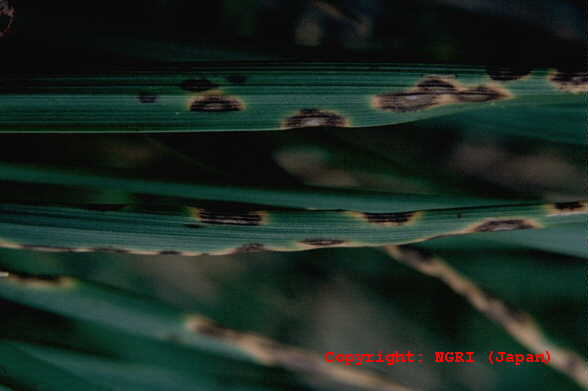
Bacterial disease which causes leaf blight occurring mainly in the warm regions. The disease produces at first water-soaked spots in leaves and then the lesions become brown and oval to spindle-shape or irregular and surrounded with yellow halos. The lesion expand to long sripe when the disease advances and finally it might invade the head spikes and seeds. The causal organism is same with that of ryegrass halo blight. |
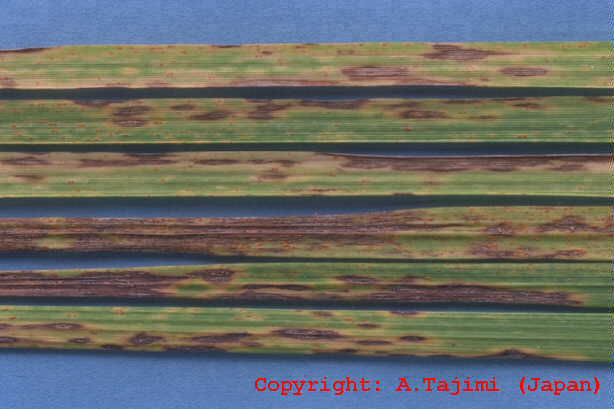 |
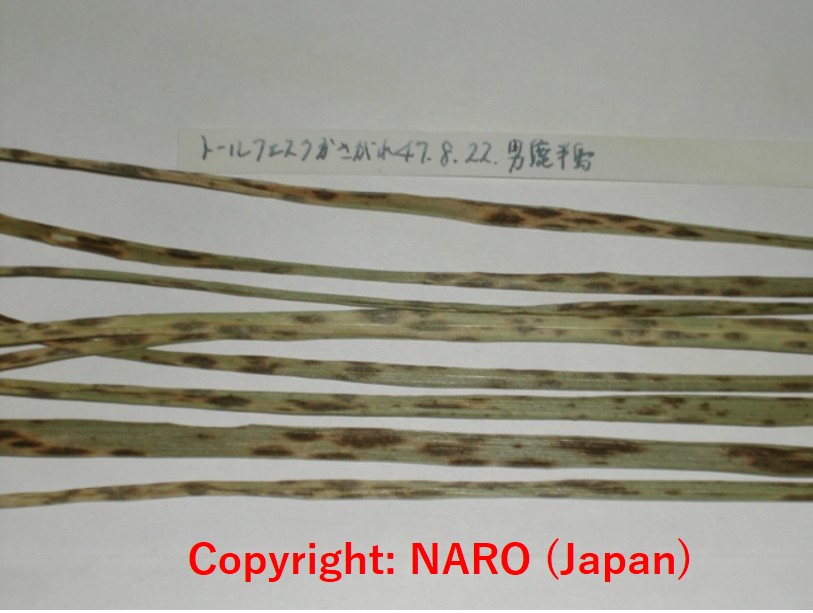
Spot-causing fungal disease which causes summer depression of grasslands in the warm regions. The lesions are at first water-soaked small spots and then expands to ash white to drab, long oval to spindle shaped ones of 5-10mm in length and 2-4mm in width. The fungal tissues, setae, are produced in the center of the old lesion and looks black moldy. Orange masses of spores are formed on the lesion under wet conditions and they disperse by wind and rain. The disease often occurs from the end of the rainy season to summer. The species of the pathogen is same with those of sorghum, orchardgrass and bahiagrass, but the pathogenicity is considered to be differentiated. |
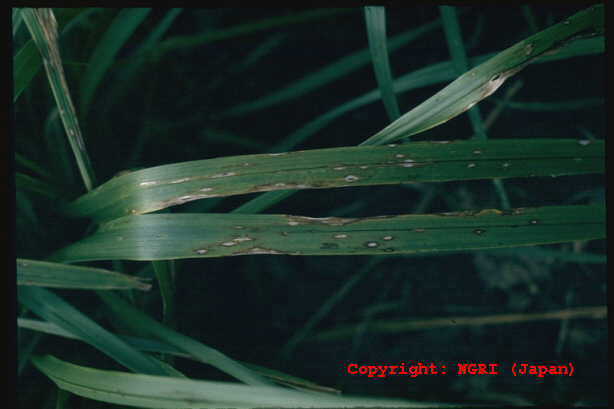 |
Spot-causing fungal disease occurring mainly in the warm regions and caused by the same fungus of rice blast. The lesions are at first brown small spots and then become ash white with blackish brown border and spindle-shaped ones of 0.3-1 cm in length and 0.2-0.5 cm in width. The damage is large when occurring in young plants. The disease may be a primary source of rice blast. Causal organism is considered to be same with rice blast fungus, but its pathogenicity may be partially differentiated.
|
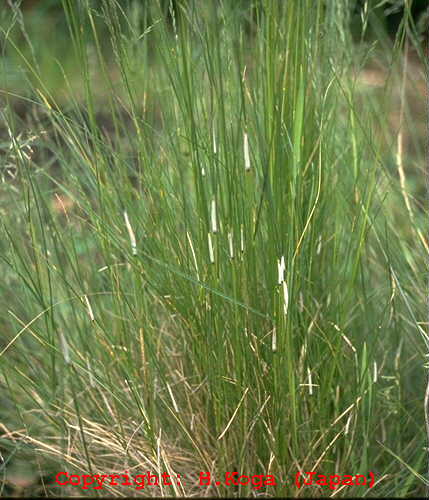 |
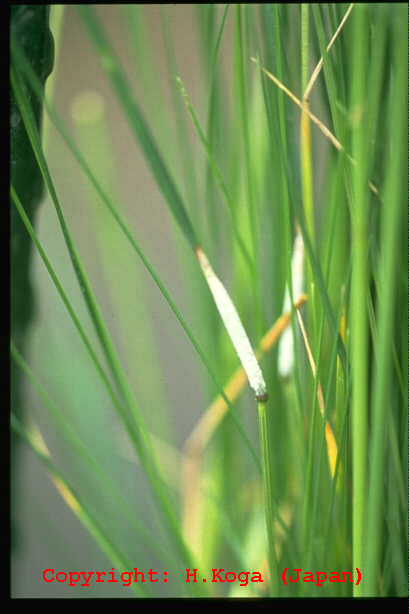
Fungal disease which was reported in chewing fescue of Tochigi Pref. in 1994. The white stroma of 1-3 cm in length like a head of bulrush are produced rolling the sheath of flag leaf in late spring, similar to choke of timothy. A lot of conidia are formed on the stroma and the heading of the infected plant is inhibited. The teleomorph of the pathogen is not found at present and the disease cycle is not well understood. The causal organism is a so-called endophyte which lives symbiotically in the plant body and the produced alkaliods may be toxic to livestocks and deterrent to insects. |
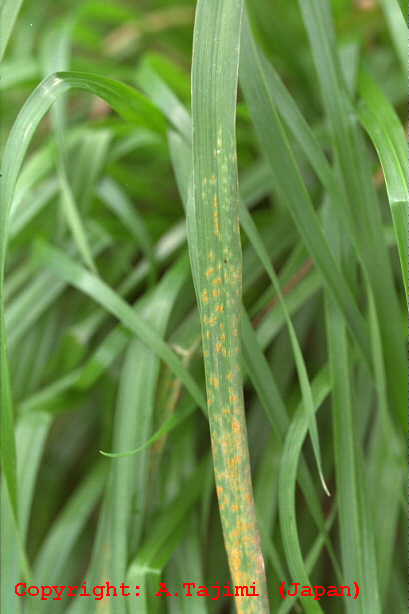 |
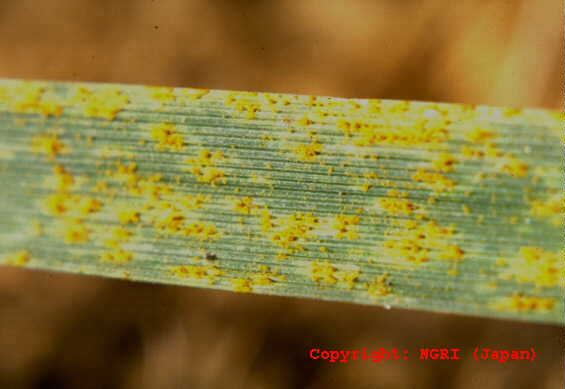
Fungal disease with large damages. The disease occurs comparatively a lot in the warm regions south of Kanto. The lesions are at first yellow swelling and then become oval ones of 1-2mm in length and 0.5mm in width. The epidermis tears and yellow to orange urediniospores appears from the inside. When occurring severely, the entire leaf looks yellow powdery and then withers. Blackish brown telia are produced later, but the pathogen is considered to overwinter and oversummer by urediniospores. The species of the causal organism is same with that of ryegrass crown rust, but the pathogenicity is differentiated. |
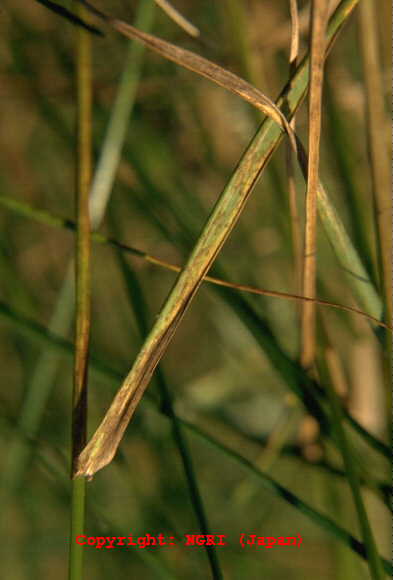 |
Spot-causing fungal disease occurring from spring to summer. The lesions are often formed from the rim or tip of leaf and become brown and half oval with indistinct border. When occurring after heading, the base of the leaf is invaded and the entire leaf often withers and falls. The species of the causal organism is same with that of ryrgrass leaf blight. |

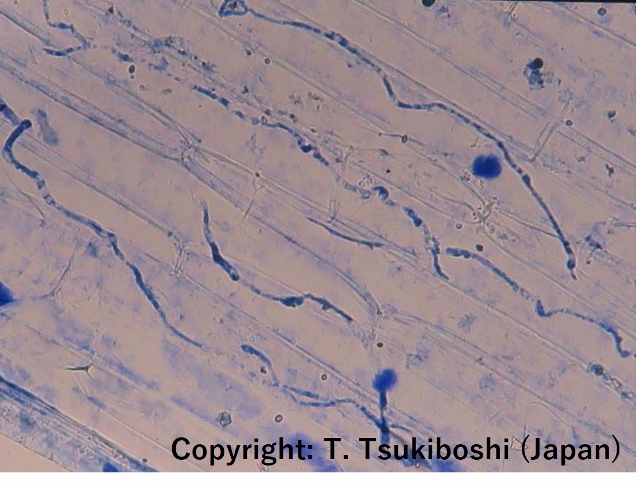 |
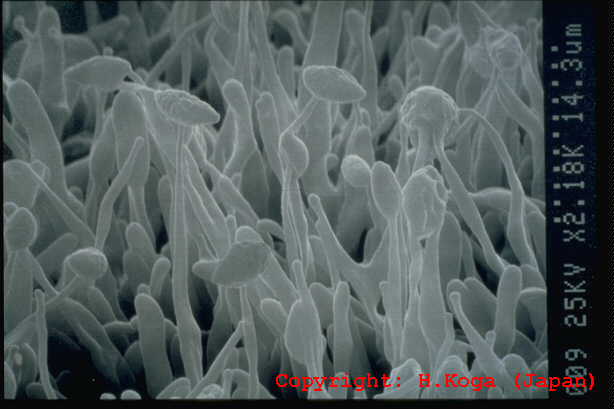
Since the causal organism is an endophytic fungus in gramineous plants, the infected plants are usually symptomless and undistinguishable from the non-infected ones. Hyphae of the fungus are colorless, rarely branched and elongate intercellularly in leaves and leaf sheaths. They intrude seeds and intercellular hyphae elongate among starch cells, becoming inocula for the next generation. It has been discovered in the ecotypes of fescue since 1990s in Japan. The infected plants acquire tolerance to insects, diseases and environmental stresses.
|
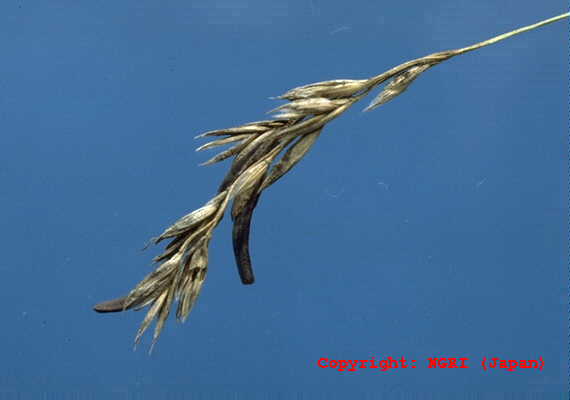 |
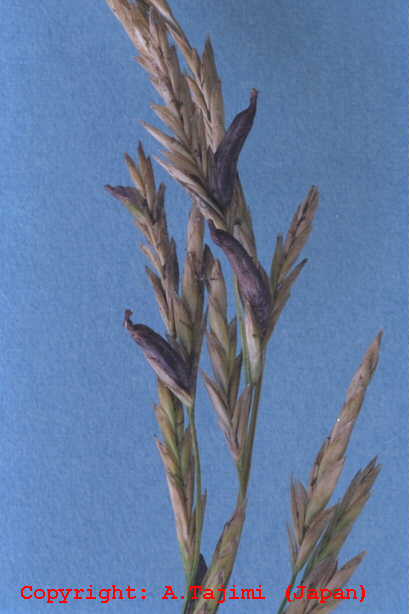
The ergots (sclerotia) are formed in the head and have toxicity to livestocks. The disease at first produces light-brown honey dew in the head just after flowering, and many spores included in the honey dew disperse and transmit by wind and rain. The black purple, cattle-horn like, ergots covered with white sphacelia of 2-18mm in length and 0.6-2.4mm in width are produced in the infected flowers replacing the seeds. The ergots drop to the ground, germinate in next year, and disperse ascospores as primary inocula. The host range is wide and the pathogen can also infect wheat, rye, timothy and ryegrass, etc. The alkaloids in the ergot are strongly toxic such as ergovaline and cause abortion and so on of livestocks.
|
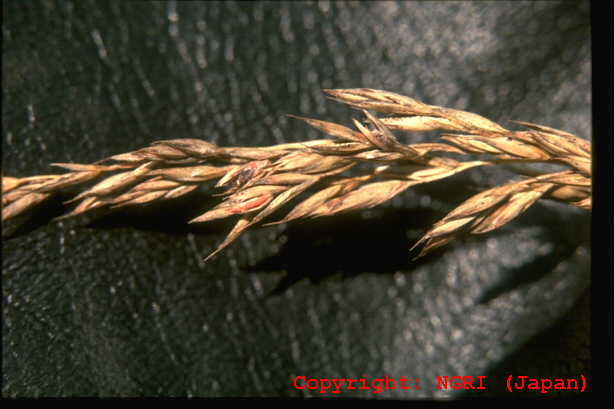 |
Fungal disease that occurs in the heads. The head spikes become red to brown and pink-colored molds grow in the joint of glume. It also occurs in the leaf and produces oval zonate lesions of a rice grain size. The causal organism exists continuously also in the soil and this becomes primary inocula. Besides, the disease occurs in a lot of cereals such as rice and wheat. |
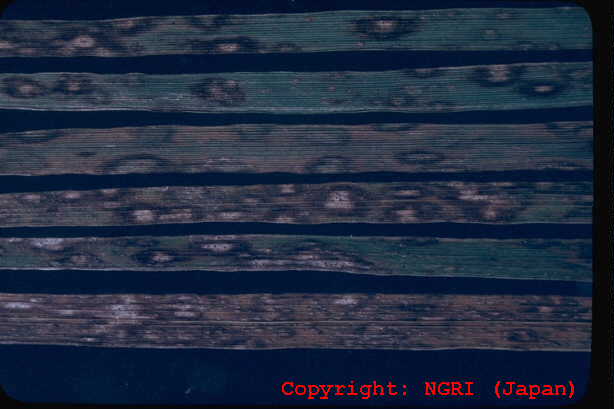 |
Fungal disease which causes leaf blight. The lesions are at first faint green, cloud-shaped and the surroundings become yellowish. They become gradually brown to drab or purple brown, oval to spindle shape spots. Later the center of the lesion fades a little and the lesions grow thick in the leaf. |
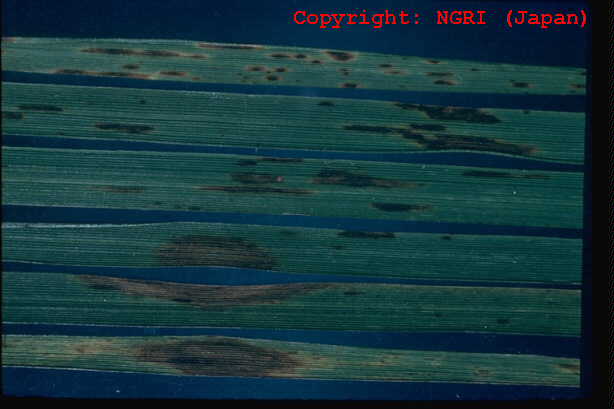 |
Fungal disease mainly occurring in meadow fescue. The lesions are at first brown small spots or short lines, and then expands gradually to brown, oval to spindle-shaped ones of 0.2-3 cm in length, and 0.1-1 cm in width. The size of the lesions vary in a wide range. The causal organism is homogeneous with summer spot fungi of ryegrass, but they may differ in pathogenicity. The host range of the pathogen is wide. |
 Return to top