 |
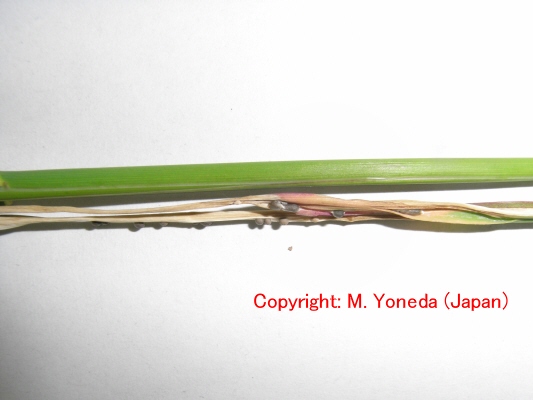
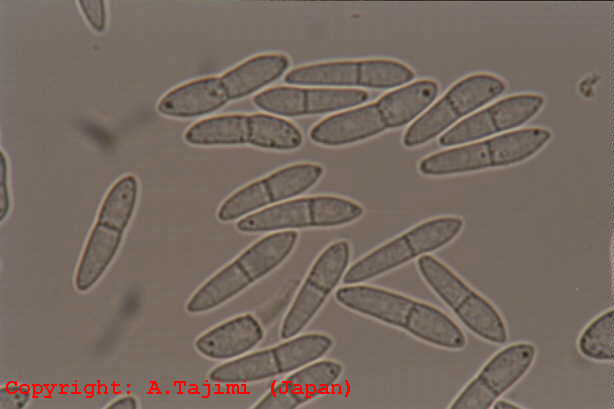
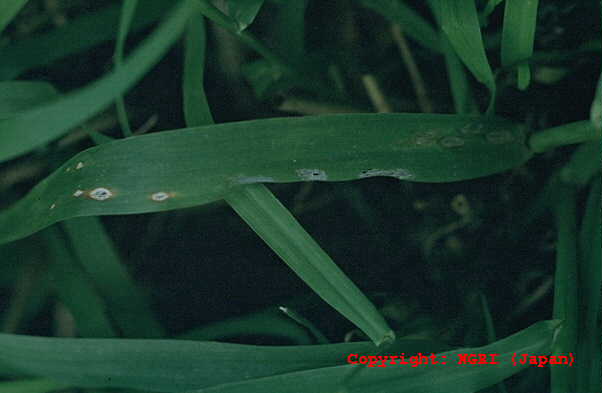
Spot-causing fungal disease occurring mainly in the warm regions. The lesions are ash white with brown border and short spindle-shaped. The lesion size is about 2-5mm, but soon they fuse mutually and cause leaf blight of the entire leaf. Causal organism is homogeneous with rice blast fungus, but its pathogenicity is partially differentiated. |
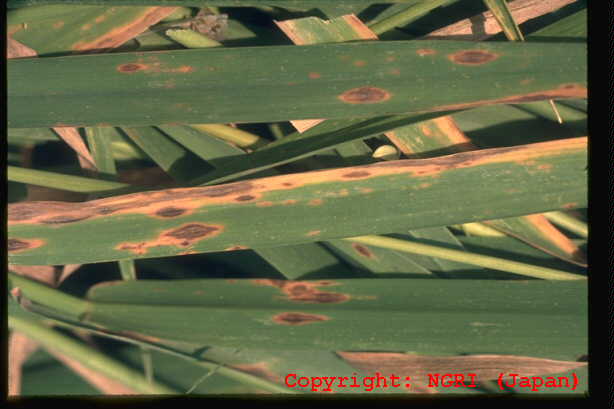 |
Fungal disease which causes leaf blight. The lesions are produced in the leaf and sheath and at first brown to yellowish white, oval spots. Then they gradually expand to yellowish brown lesions with an indistinct border. They fuse mutually and the infected leaf turns to yellowish brown and withers. It spreads from the end of summer to autumn. |
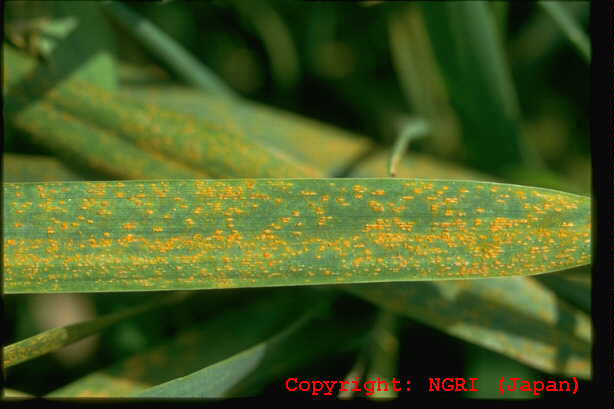 |
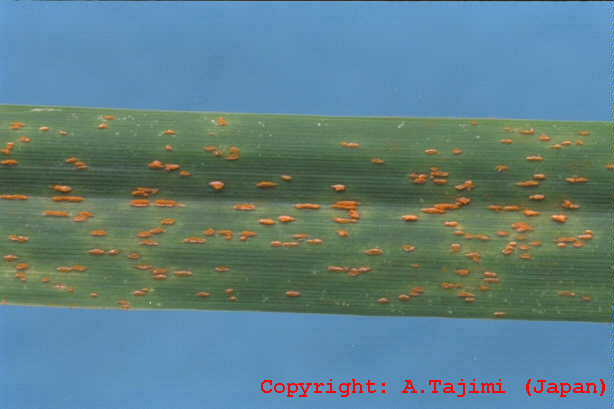
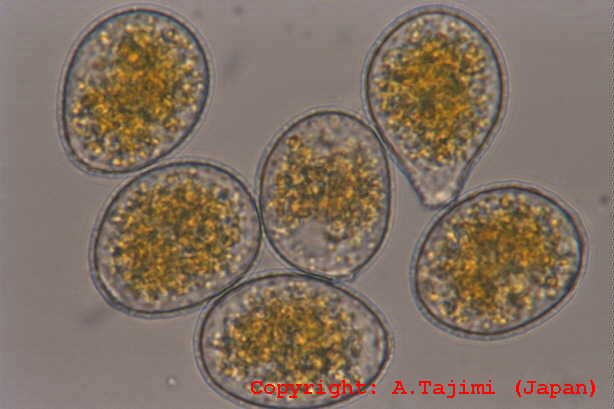
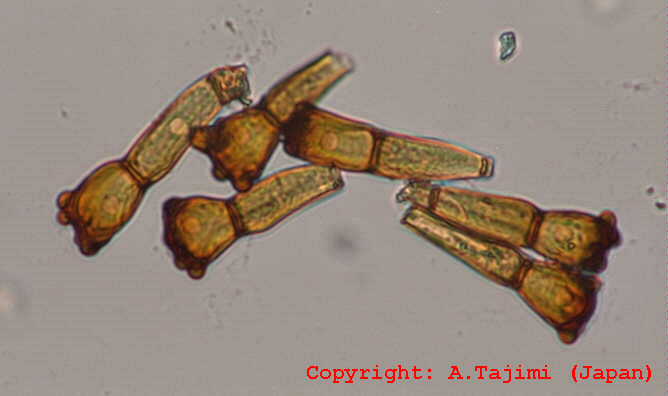
An important rust disease whose damage is large. The disease occurs comparatively a lot in the warm regions south of Kanto. The lesions are at first yellow swelling and then become oval ones of 1-2mm in length and 0.5mm in width. The epidermis tears and yellow to orange urediniospores appears from the inside. When occurring severely, the entire leaf looks yellow powdery and then withers. Blackish brown telia are produced later, but the pathogen is considered to overwinter and oversummer by urediniospores. The species of the causal organism is same with that of fescue crown rust. |
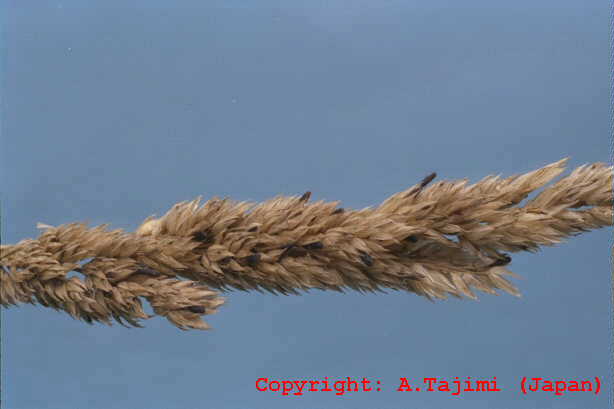 |
The ergots (sclerotia) are formed in the head and have toxicity to livestocks. The disease at first produces light-brown honey dew in the head just after flowering, and many spores included in the honey dew disperse and transmit by wind and rain. The black purple, cattle-horn like, ergots covered with white sphacelia of 2-18mm in length and 0.6-2.4mm in width are produced in the infected flowers replacing the seeds. The ergots drop to the ground, germinate in next year, and disperse ascospores as primary inocula. The host range is wide and the pathogen can also infect wheat, rye, timothy and fescue, etc. The alkaloids in the ergot are strongly toxic such as ergovaline and cause abortion and so on of livestocks.
|
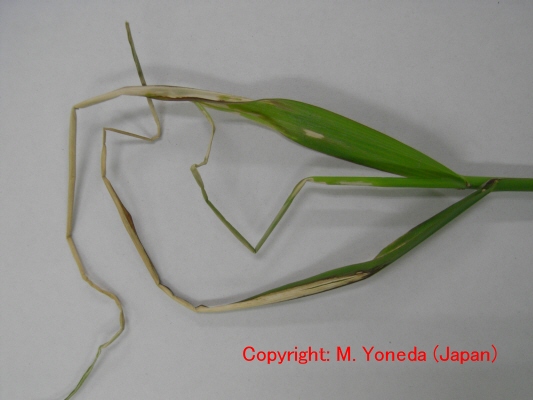 |
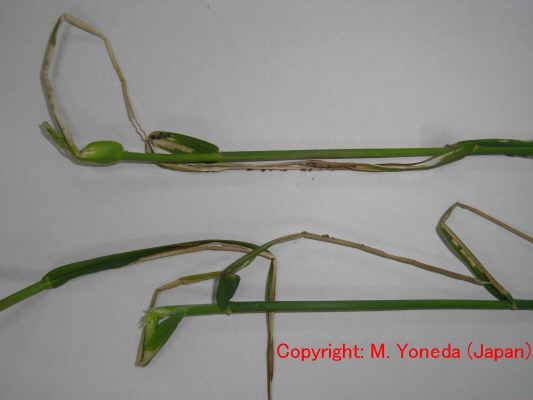
The occurrence has been reported in 1970's in Hokkaido, the most northern area, Japan. In June 2011, the disease again occurred in Makubetsu, Hokkaido. The symptoms are characterized with white rot of leaf tips, resulting the infected leaves remained rolling in the buds. Lesions are elliptical to irregular-shaped, white in center with reddish brown border. Sclerotia gray, spherical to sub-spherical, smooth on the surface, 1-3 mm in diameter are usually produced on the lesions. |
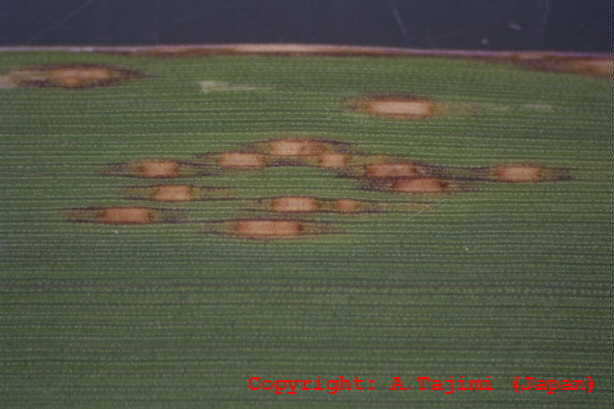 |
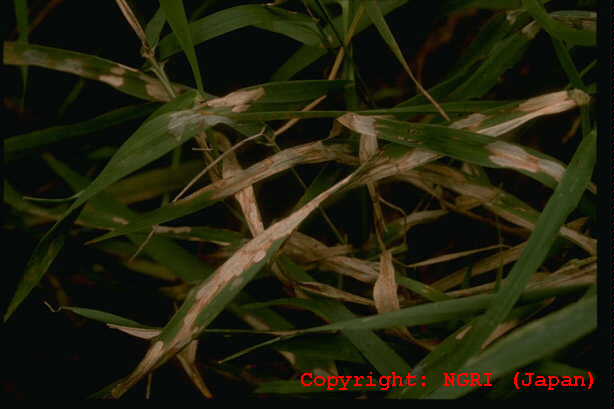
Important, spot-causing fungal disease occurring all over the country. The disease is occurring in Hokkaido, the northern part, through year, although occurring in Kanto area, the central part, in spring and autumn. The lesions are at first water-soaked small spot, and then become faint orange to ash white with brown border, long spindle to lens shape, 1-3cm in length and 2-5mm in width, characteristic lesions. The lesions fuse gradually and becomes cloud-shaped ones. The infected leaf often tears from the lesion part. The disease occurs severely under the cool and wet condition. The species of the pathogen is same with that of barley scald, but the pathogenicity is differentiated. |
 |
An Important fungal disease which occurs all over the country and becomes a cause of summer depression of grassland. Ash green and water-soaked lesions appears at first and the whole infected plant soften like being boiled before long. Then, the infected stalks and leaves fall one upon another and rot when the disease progresses and hyphae like spider' web appear covering all the infected part. Later light brown to brown sclerotia of about 5mm in diameter are produced on the infected part. At this point, the infected grass withers forming patches and the grassland gradually becomes bare land. The causal organism is polyxeny and can infect most grasses and legumes of herbage.
|
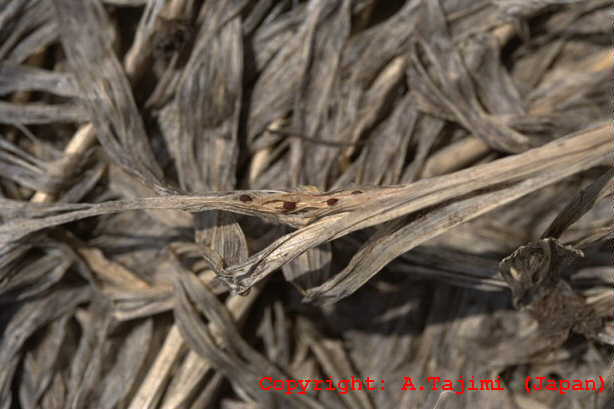 |
Important fungal disease which causes plant death and occurs mainly in Hokkaido, the most northern part of Japan. The symptom is similar that of T.ishikariensis, but the sclerotia formed on the surface of withering part is reddish brown and millet grain size. The sclerotia is formed on the stalks, leaves, and roots, etc. of the withering plant. The pathogen is more saprophytic than T.ishikariensis and is considered to invade after invasion of T.ishikariensis and occur mixingly with it. |
 Return to top