 |
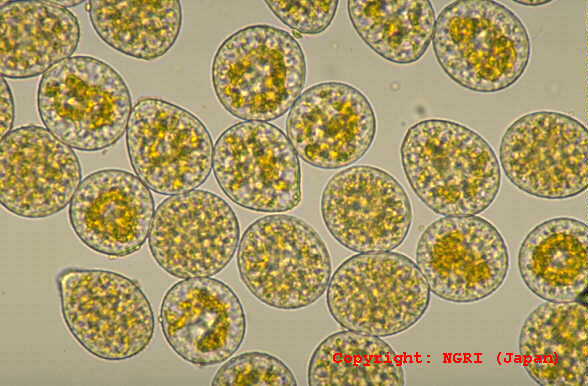
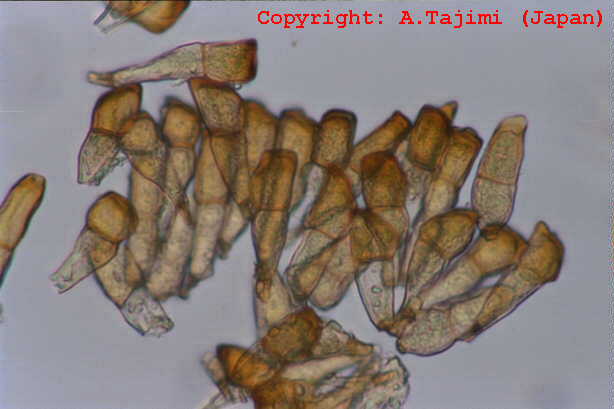
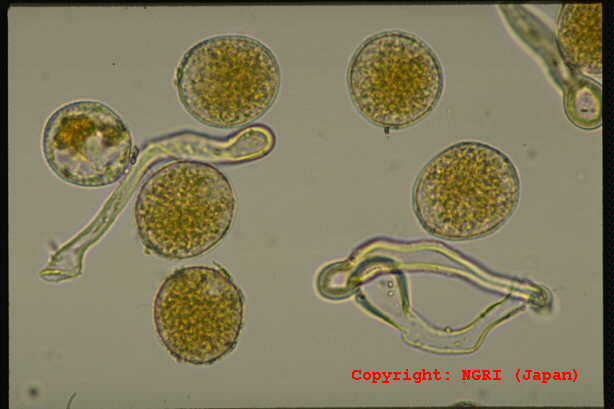
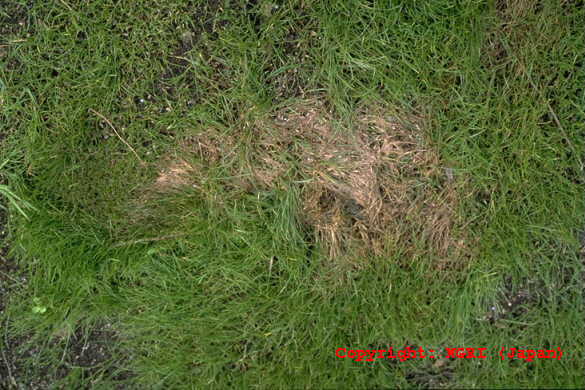
An Important fungal disease which occurs all over the country and becomes a cause of summer depression of grassland. Ash green and water-soaked lesions appears at first and the whole infected plant soften like being boiled before long. Then, the infected stalks and leaves fall one upon another and rot when the disease progresses and hyphae like spider' web appear covering all the infected part. Later light brown to brown sclerotia of about 5mm in diameter are produced on the infected part. At this point, the infected grass withers forming patches and the grassland gradually becomes bare land. The causal organism is polyxeny and can infect most grasses and legumes of herbage. AG-2-2 IIIB, AG-1 IA and IB of R.solani cause the disease.
|
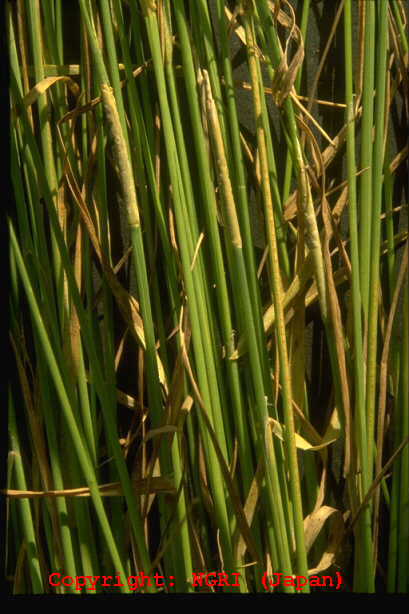 |
Fungal disease which inhibits heading and becomes problem in seed production. The white stroma of 1-3 cm in length like a head of bulrush are produced rolling the sheath of flag leaf in late spring. A lot of conidia are formed on the stroma. |
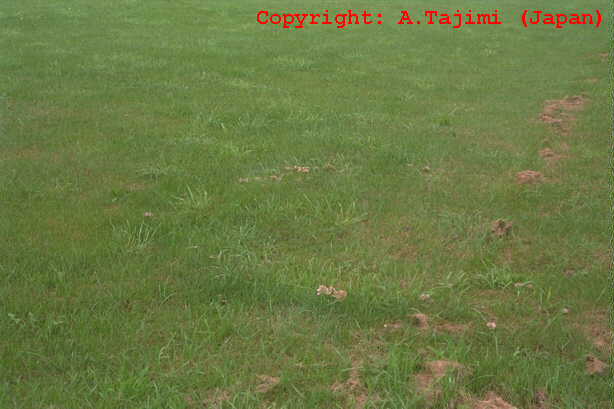 |
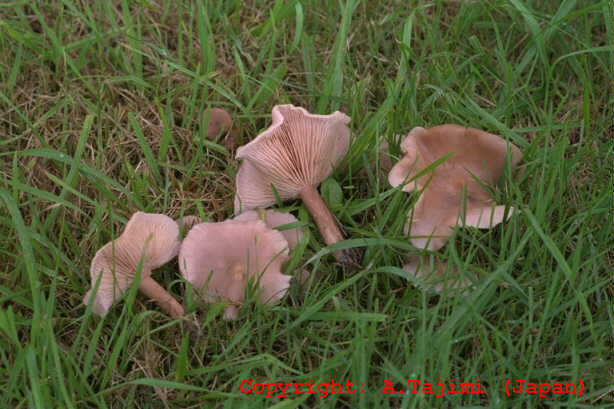
Fungal disease occurring in many kinds of turf from spring to early summer. The patch is at first dark green, round ones, then it expands to 1-2 m in diameter with a characteristic ring of 10-20cm in width. The inside of the patch withers not so much. When the humidity of soil rises by rainfall, etc. at the end of summer, an infected fungi often forms the mushroom. Other kinds of Basidiomycotina are reported as causal organisms. |
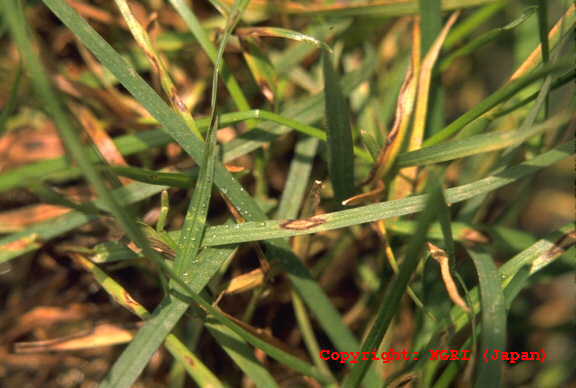 |
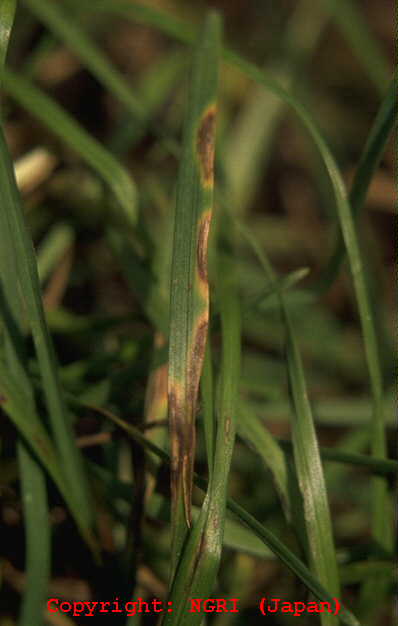
Fungal disease which causes withering of many plant bodies when occurring severely. It at first produces oval to spindle shaped lesions with reddish brown border sporadically in the leaf. When the disease advances, the pathogen invades crown and root and causes the plant withering. The decline of the turf is caused as a result and it becomes like "melting-out". The causal organism is a kind of the Helminthosporium fungi. |
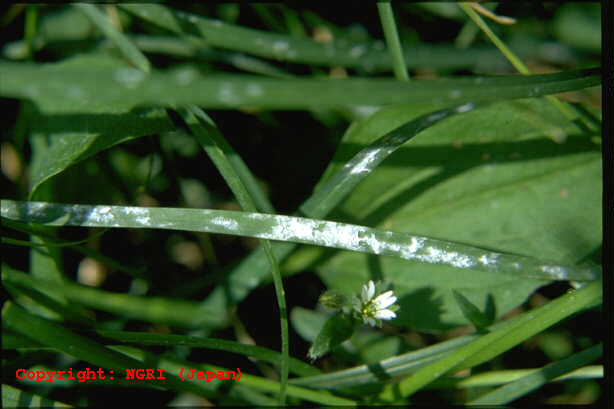 |
Powdery mildew disease is occurring only in bluegrass as for turfgrass in Japan. The lesions are at first white silky colony on the leaf and soon enlarge and fuse mutually. Then the lesions turn to gray and powdery. It occurs severely under the low irradiation and high humidity condition. Infected turf looks white and dirty in the enlarged area. The pathogenicity id differentiated to bluegrass. |
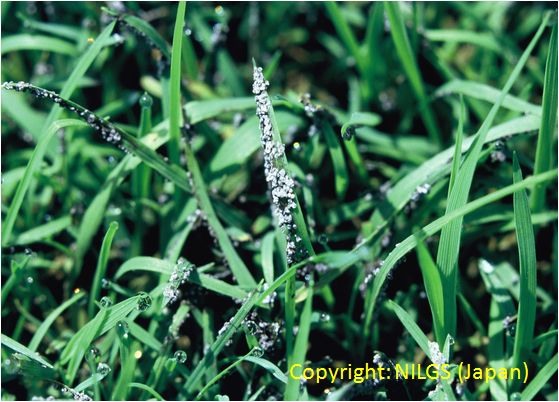 |
The causal organism does not cause a disease, but inhabit saprophytically on the plants. Firstly, it produces small white massive bodies from the rainy season to early summer, later it changes gray small mass like bird craps on the leaves. When occurring severely, the bodies stuck in the wide area of the cultivated plants. In the turf, it often appears as grayish patches. The bodies are sporangia and disperse many spores by rain, wind and machinery cutting. It causes the same symptom on the other turf grasses such as Zoysia grass and ryegrass. Mucilago crustacea are also known as a causal organism in Japan. |
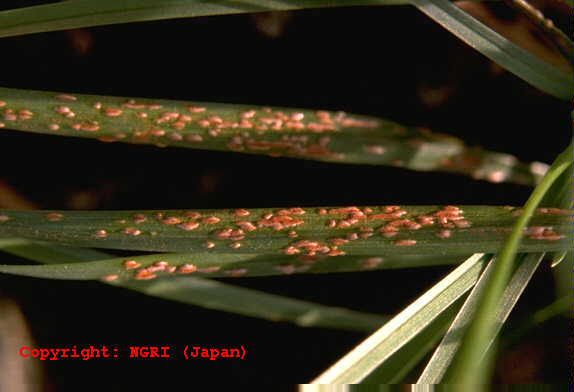 |
One of the rust diseases and the damage is not so large. The uredinia are scattered in both the leaf side, reddish brown to iron rust color, oval to sripe, about 1-2x0.5-1mm in the size. They often fuse and become to irregular shape. Blackish brown telia are produced in the leaf from summer to autumn. |
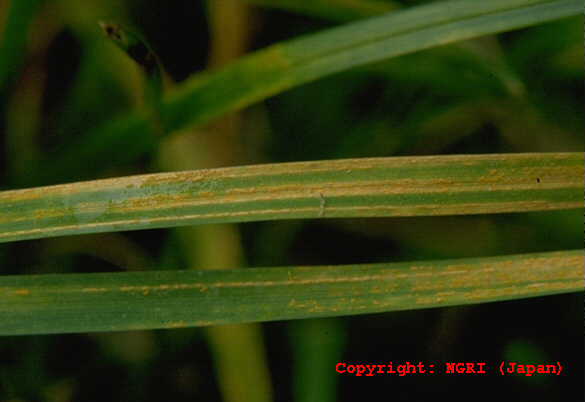 |
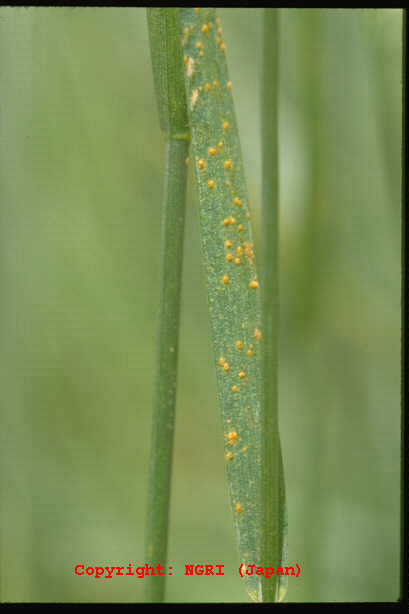
One of the rust diseases and the damage is not so large. It produces orange yellow, oval, swelling lesions of about 1mm in length in the leaf, sheath, and culm. The lesions are characteristic to appear in a row along the leaf vein. The epidermis tears when maturing and disperses urediniospores. Ash yellow telia often occur on the leaf back, upheave not so much. The causal organism is considered to be same with that of yellow rust of timothy. |
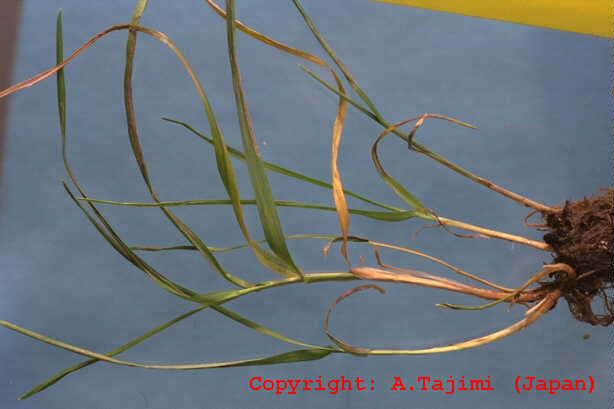 |
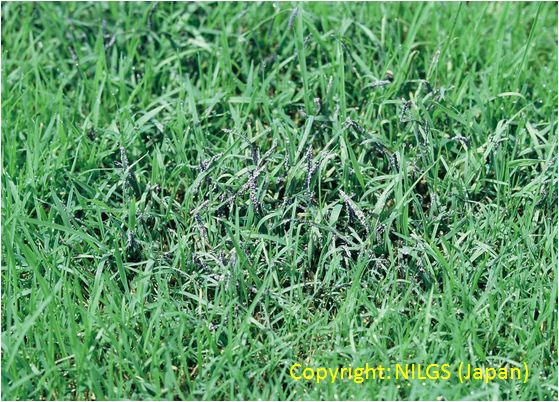
Fungal disease occurring in Hokkaido, the northern part of Japan. The damage is most distinct from June to July. The black powdery stripes are formed on the leaf, sheath and culm. The surface of the lesion tears and exposes black powder, the smut spores, and they disperse by wind and rain. The lesion part often splits later. The infected plant often shrinks and can not do heading. |
 |
Fungal disease occurring in the leaf. The lesions are black, long oval to short linear, 0.2-5x0.1-1mm in size. They are often produced on the upper surface of the leaf and upheave a little. Yellow halo is produced in the surroundings of the lesion, but it often disappears gradually and only the surroundings occasionally keep green. |
 |
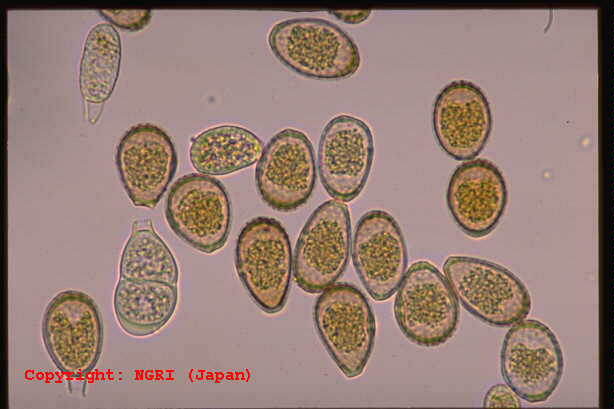
Rust disease whose damage is large in bluegrass. It produces circle to long oval uredinia on the leaf surface. Then the epidermis tears and exposes yellowish orange powder (urediniospore). When occurring severely, the uredinia are formed in the leaf bristly and the entire leaf looks yellow. Telia is black, long oval to linear, covered by epidermis for a long time, upheaving a little. |
 Return to top