 |
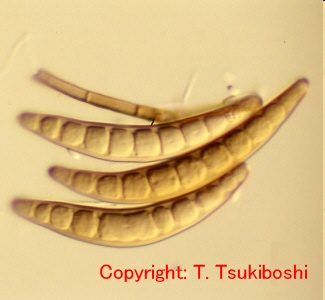
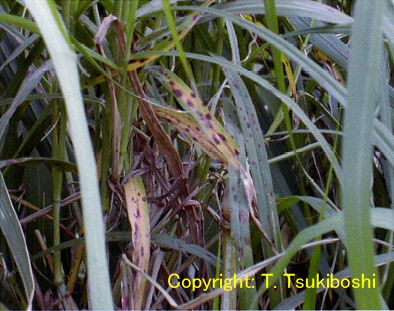
Fungal disease occurring in leaf and sheath. The lesion is brown to reddish brown, oval to long oval, 1-5x0.5-2cm in size. The inner parts of lesions frequently show zonation and the surroundings of the lesion turn to yellow. Later the lesions fuse mutually and become irregular shape and this causes leaf blight. Pathogens has been identified as B. sacchari, but other species can cause the disease. |
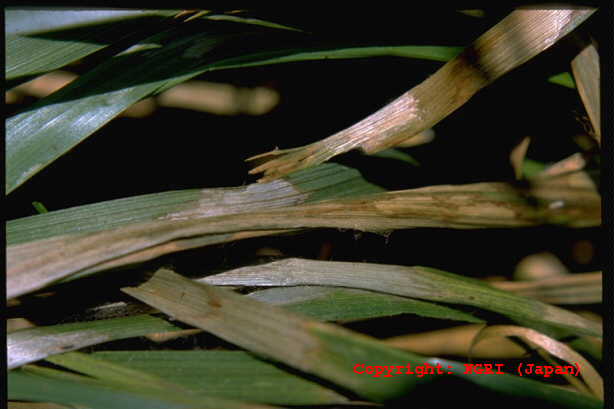 |
An important fungal disease which leads to withering of the entire plant body if occurring severely. The disease firstly occurs in the ground side of stem around the rainy season and progresses up through sheaths. The lesion becomes cloud-shaped, ash white with brown border. Brown sclerotia with a smooth surface are produced on the lesion at the latter stage of the occurrence. They drop to ground, and become the primary inocula of next year. It occurs severely under high temperature (especially 30C or more) and high humidity condition. The pathogen is common in summer blight of pastures and sheath blight of rice, corn and sorghum, etc. |
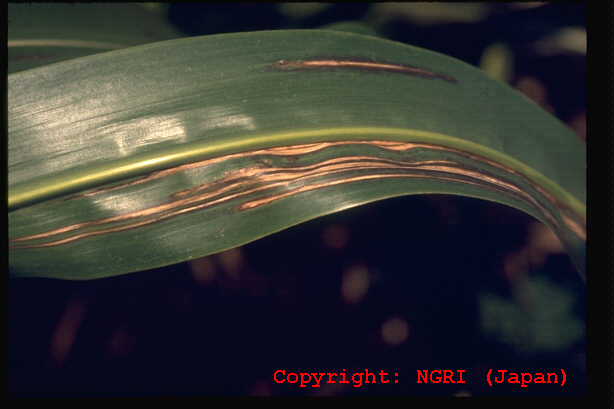 |
Bacterial disease occurring in leaves. Lesions are at first water-soaked small spots, and they expand gradually to oval, ash white ones with brown border. Then the lesion extends long further along leaf veins, and becomes a stripe which reaches 5-10cm in length. The lesion becomes irregular shape when fusing and the whole leaf becomes white and withers when occurring severely. |
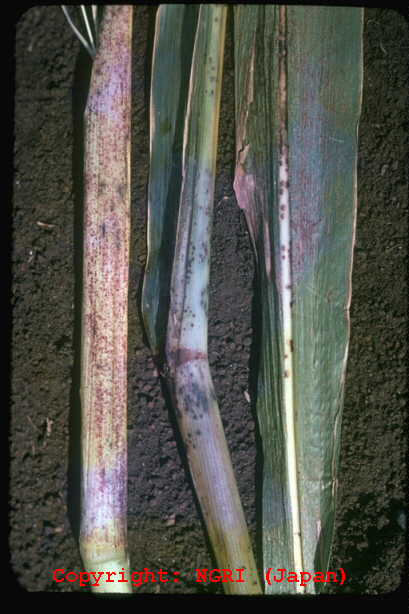 |
Fungal disease occurring in leaves and sheaths. Lesions are brown to brownish purple, circle to oval, 2-5mm in diameter, and occurs a lot on a midrib of leaf or sheath, etc. The lesions protrude a little, fuse mutually before long and become large irregular-shaped ones. The epidermis of the lesion is broken and looks like rust-colored and powdery. |
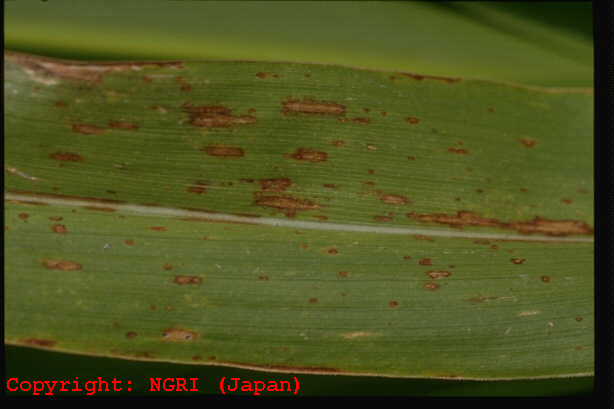 |
Fungal disease occurring in leaf and sheath. The lesion is yellowish brown to brown, long oval to spindle shape or short linear shape, 3-20x1-5mm in size. The border parts of lesions are brown and the boundary with surroundings is distinct. Later the lesions fuse mutually and become irregular shape and this causes leaf blight. |
 Return to top