 |
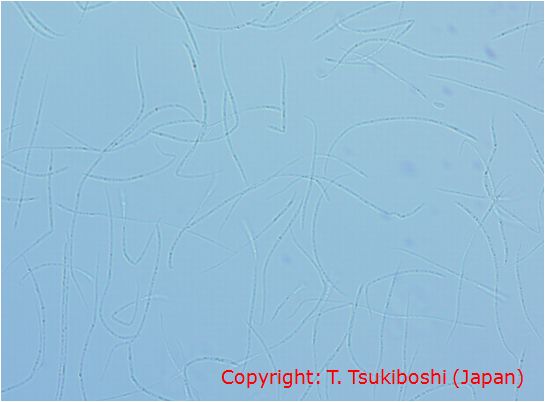
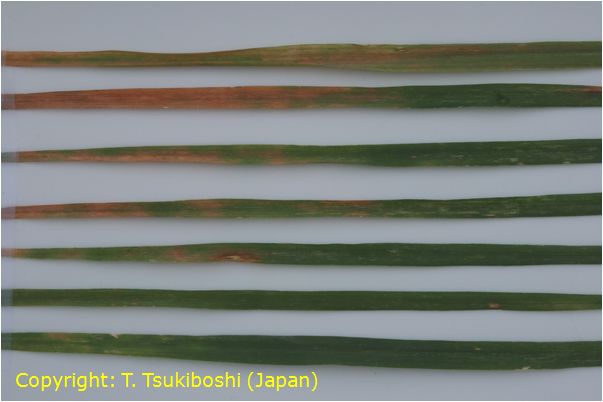
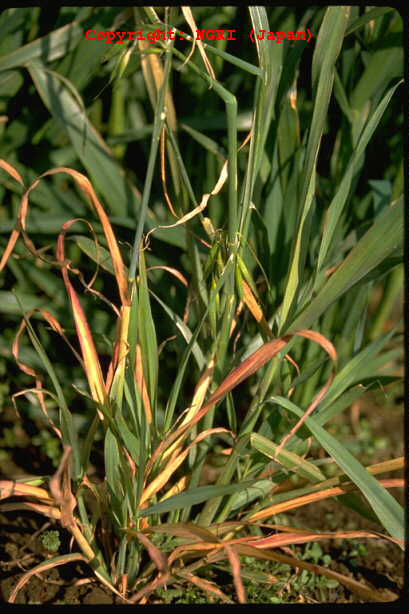
Viral disease in which leaf discolors in red. The leaf discolors in red from the tip and rim getting blurred. The leaf withers and the whole plant shrinks when occurring severely. The causal viruses can infect ryegrass and drooping wheatgrass, etc. and are transmitted by aphids. |
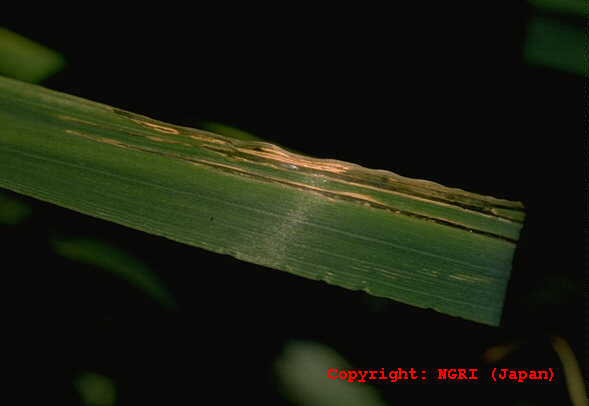 |
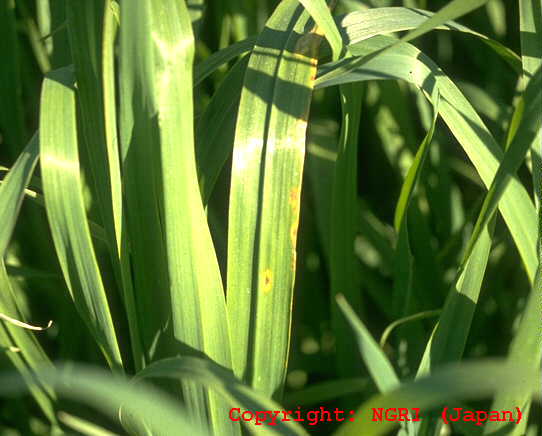
Bacterial disease occurring in the low temperature term from March to May. The lesions are at first water-soaked spots in leaves and sheaths, later becomes a long brown stripe of 5-20cm in length and 1-2mm in width back. The surroundings of lesions discolor yellow. When occurring severely, the pathogen invades the growing point and the infected plant withers. |
 |
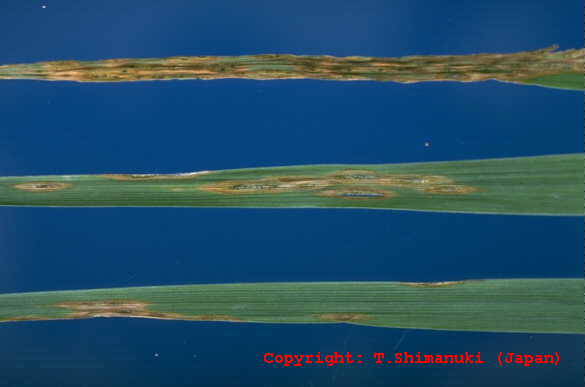
Bacterial disease which causes leaf blight occurring mainly in the warm regions. The disease produces at first water-soaked spots in leaves and then the lesions become brown and oval to spindle-shape and surrounded with yellow halos. The lesion expand to long stripe when the disease advances and finally it might invade the head spikes and seeds. |
 |
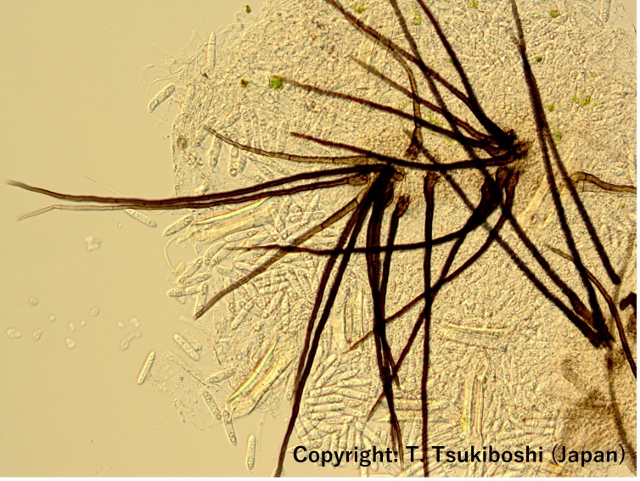
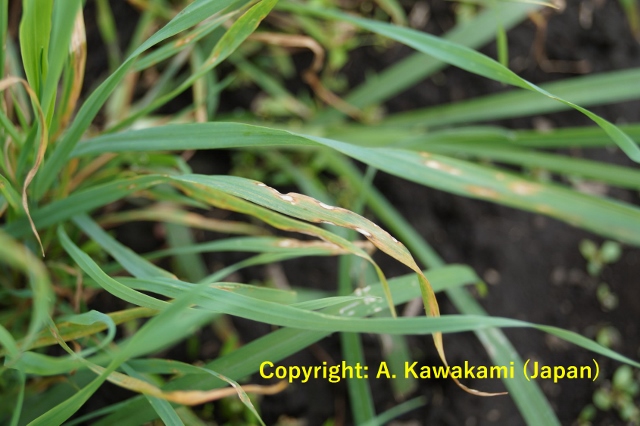
Spot-causing fungal disease occurring from the end of the rainy season. Lesions are yellowish brown to orange, oval, and 5-30x1-5mm in size. Later they fuse mutually and become irregular shape. When the lesion becomes old, the center of the lesion becomes black moldy because of production of setae, fungi tissues. Orange slimy mass of spores are formed among the setae, and these disperse and spread by wind and rain. The species of the causal organism is same with those from sorghum, orchardgrass and ryegrasses, but the pathogenicity is differentiated. |

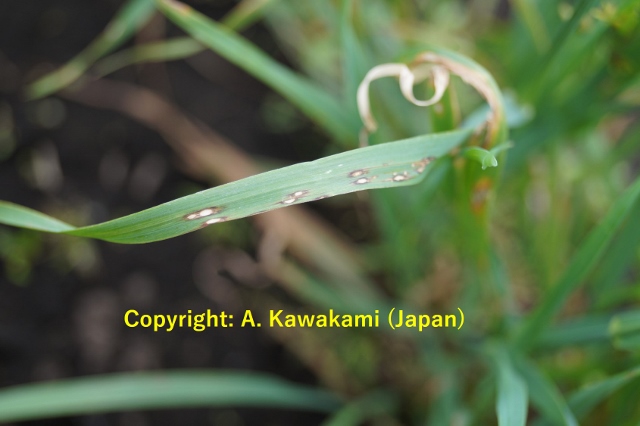 |
Spot-causing fungal disease occurring mainly in the warm regions from Kyushu to Chugoku districts. The lesions are ash white with brown border and short spindle-shaped or oval. The lesion size is about 5-10mm, but soon they fuse mutually and cause leaf blight of the entire leaf. Causal organism is homogeneous with rice blast fungus, but its pathogenicity is differentiated, and shows pathogenicity to ryegrass, but not to rice, barley and wheat.
|
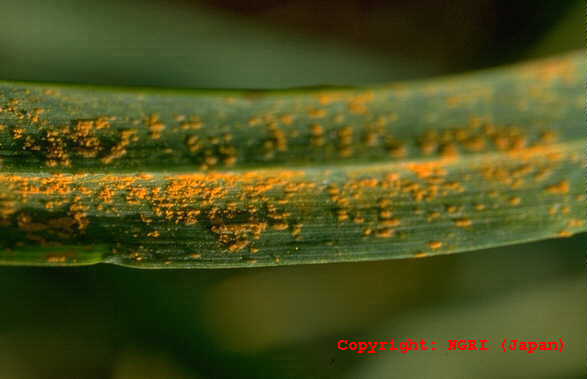 |
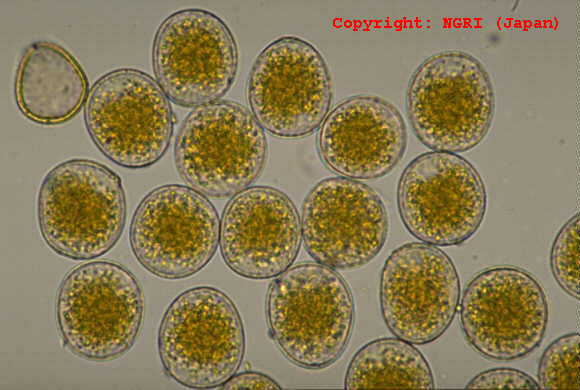
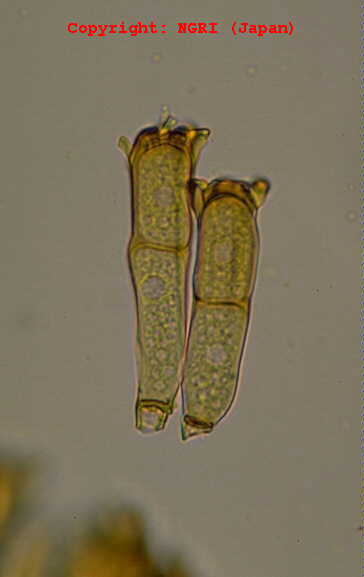
The important rust disease whose damage is large mainly in warm regions, Kanto District south. The lesions are at first like swellings, and then become oval lesion of 1-2mm in length and about 0.5mm in width. The epidermis of the lesion tears and yellow to orange urediniospores appear from the inside. When occurring severely, the whole leaf looks like yellowish powdery and then it withers. Black brown telia is also formed. The alternate host of the causal organism is Ramnus japonica. A lot of race are known. |
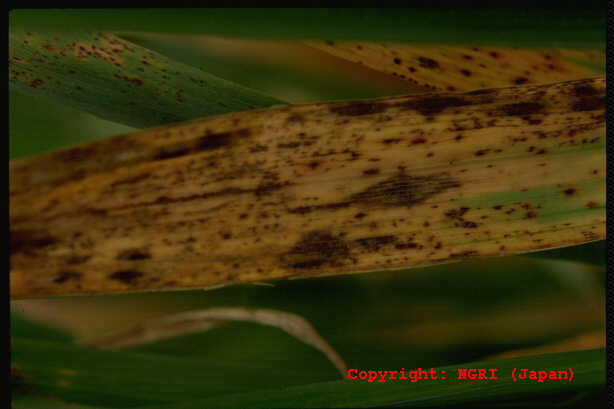 |
Spot-causing fungal disease mainly occurring in leaves. The disease at first produces black brown and small spots irregularly, and then these expands to rectangular to oval lesions. Later black molds are bristly produced on the surface of the lesion and the lesion looks black. The surroundings of the lesions turn to yellow and the leaf withers before long. |
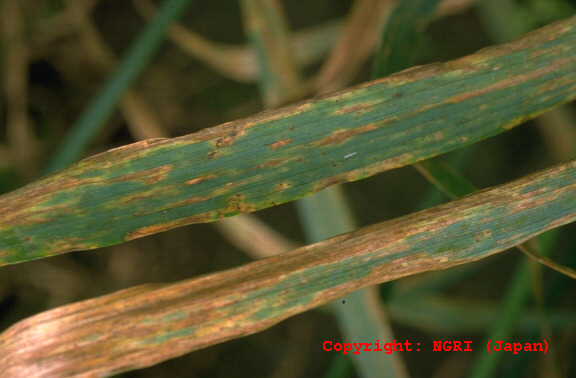 |
Leaf-blight causing fungal disease ocurring increasingly in Kyushu District, the southern part of Japan. The disease occurs in the entire upper ground part such as leaves, sheaths, and glumes. The lesion is at first brown, small spots in leaves, and then expands to stripe of 5-10mm in length and 1-2mm in width. The surroundings of the lesions turn to yellow severely and the entire leaf withers before long. The surface of the lesion sometimes become moldy and the sign is conidia of the pathogen. |
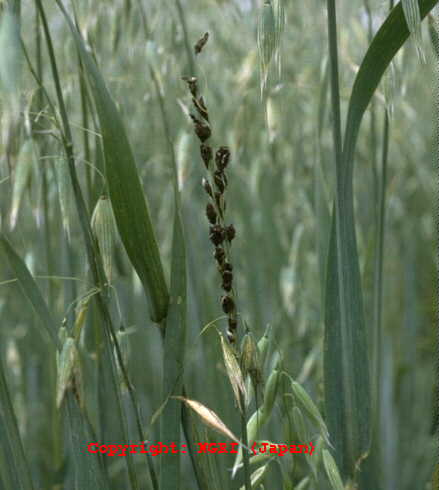 |
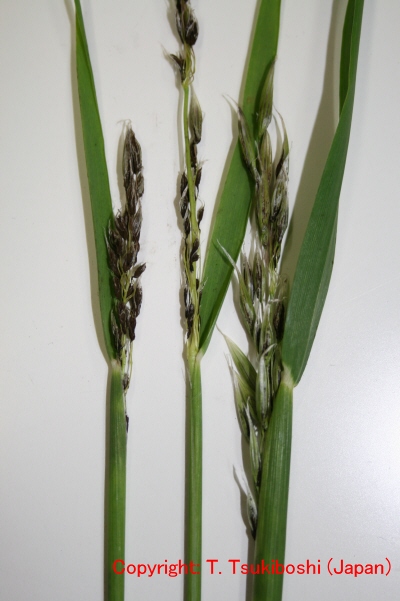
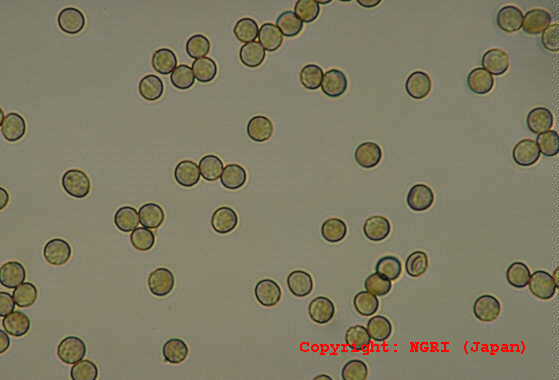
Fungal disease making grain black powdery. The pathogen infect when flowering, and then the ovary swells making the inside of the seeds black powdery. When matured, the husk tears, and disperses black powder (smut spore). All the grain are infected when occurring severely and only the head spikes are left. The pathogen transmits in the form of hyphae and the smut spores exist for a long term in the soil. |
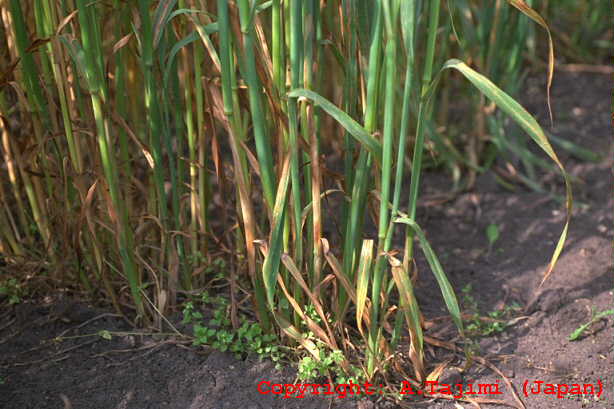 |
Fungal disease occurring in the whole upper ground part. The disease firstly occurs in the ground side of stem around the rainy season and progresses up through sheaths. The lesion becomes cloud-shaped, ash white with brown border. Brown sclerotia with a smooth surface are produced on the lesion at the latter stage of the occurrence. They drop to ground, and become the primary inocula of next year. It occurs severely under high temperature and humidity conditions. |
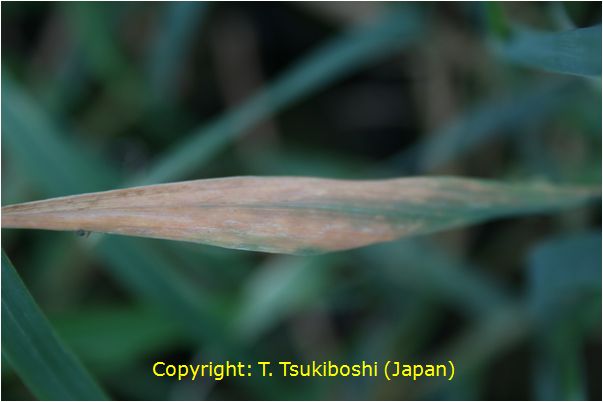 |
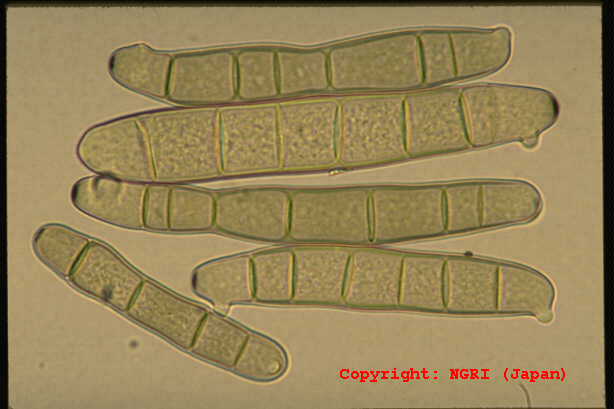
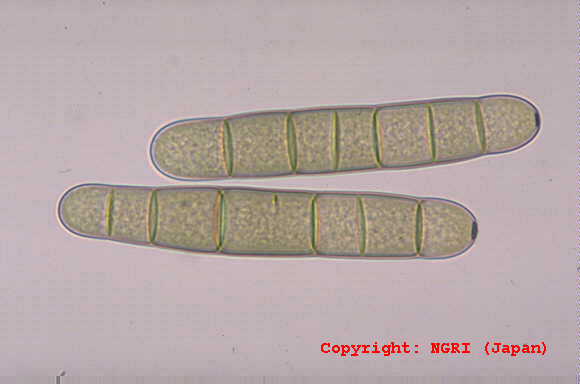
Fungal disease occurring in the leaves. The lesions are first light brown, zonate, ellipsoidal, about 1cm in diameter, later enlarge and kill the whole leaves. The causal fungus produces transparent, long whip-shaped, curved conidia. Since it does not infect sorghum, the pathogenicity should be differentiated from sorghum isolates. Some differences in resistance are observed in oat varieties to the disease. |
 Return to top