 |
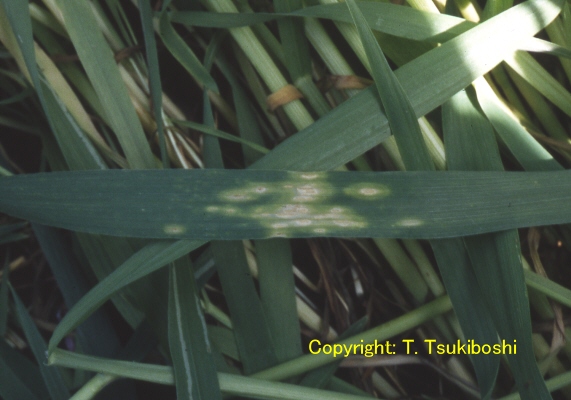
Bacterial disease which occurred recently in Ibaraki, Japan. The
disease produces at first water-soaked spots in leaves and then the
lesions become grayish to yellowish brown and oval to spindle-shaped, 5-20mm x
2-5mm in size and surrounded with yellow halos.
|
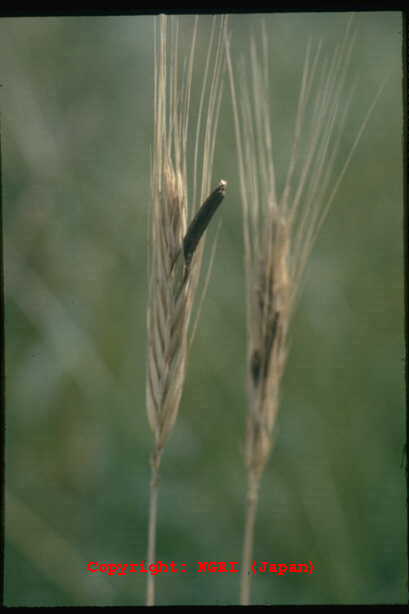 |
The ergots (sclerotia) are formed in the head and have toxicity to livestock. The disease at first produces light-brown honey dew in the head just after flowering, and many spores included in the honey dew disperse and transmit by wind and rain. The black purple, cattle-horn like, ergots covered with white sphacelia of 15-25mm in length and 2.5-3.5mm in width are produced in the infected head replacing the seeds. The ergots drop to the ground, germinate in next year, and become disease spreader. The host range is wide and the pathogen can also infect orchardgrass, timothy and fescue, etc. The alkaloids in the ergot are strongly toxic such as ergovaline and cause abortion and so on of livestocks. |
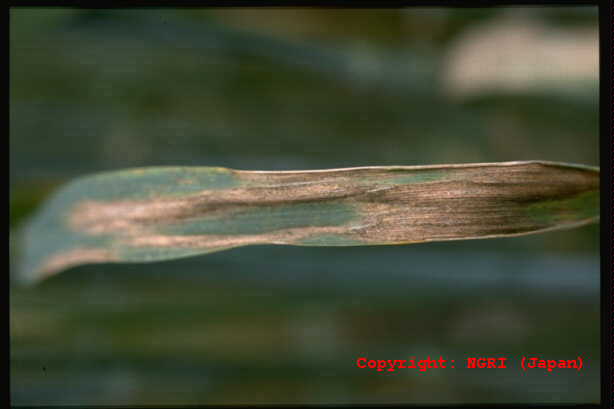 |
Spot-causing fungal disease mainly occurring in leaves. The lesions are at first water-soaked spots, then expands gradually and becomes faint brown, spindle shape, large lesions of 0.5-1cm in length. Later these fuse and kill the entire leaf. Damage is large when occurring in the young plants in the autumn. The causal organism is one of graminicolous Helminthosporium fungi and the host range is wide. |
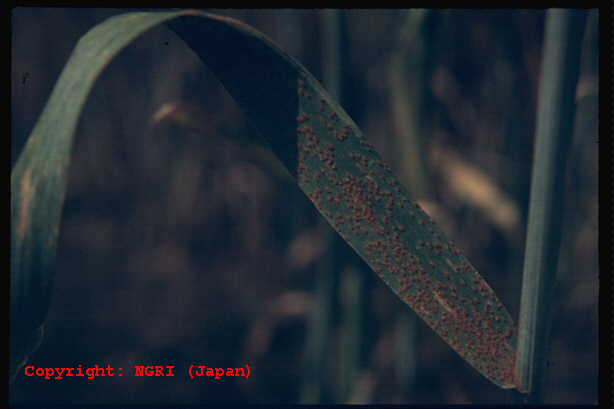 |
Representative rust disease of rye. The disease produces powdery uredinia that the epidermis tears on leaves, sheaths, and the stalks. Uredinia are small and reddish brown and often scattered without fusing mutually. Later black brown telia are formed and the epidermis do not often tear. |
 |
Fungal disease which causes plant withering under snowfall and distributes in Kanto north. Infected leaf and stem under snow soften, wither, and look pink. The pathogen does not produce sclerotia. The occurrence of the disease was reported also in the turf without snowfall. The pathogen has been considered to produce nivalenol as a mycotoxin, it was clarified that that of Japan never produces the toxin. |
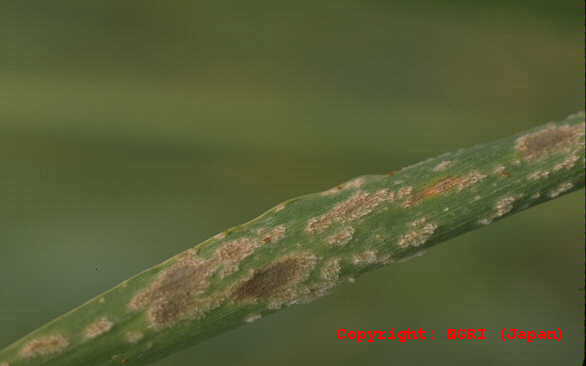 |
White molds are produced in the entire upper ground part of plants. The disease produces at first white colony on the plant body, and this becomes an oval lesion of about 5mm in size. The colony becomes gray to faint brown and the whole plant looks powdery and turns to yellow. The species of the pathogen is same with those of other gramineous plants, but the pathogenicity is differentiated and it can infect only rye. |
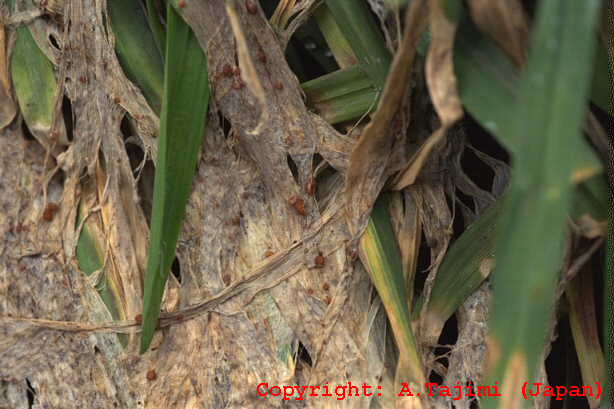 |
Important fungal disease which causes plant death and occurs mainly in Hokkaido, the most northern part of Japan. The symptom is similar that of T.ishikariensis, but the sclerotia formed on the surface of withering part is reddish brown and millet grain size. The sclerotia is formed on the stalks, leaves, and roots, etc. of the withering plant. The pathogen is more saprophytic than T.ishikariensis and is considered to invade after invasion of T.ishikariensis and occur mixingly. |
 Return to top