The Institute for Agro-Environmental Sciences, NARO (NIAES) is the core institute of the National Agriculture and Food Research Organization (NARO) which emphasizes basic studies and research meant to ensure the safety of agricultural production environments. Research focuses on assessing risk in agricultural environments and developing risk management technologies, elucidating the structure of agricultural ecosystems in order to develop technologies to manage natural cycles, and fundamental studies to help elucidate the functions of agricultural ecosystems.
NIAES News
First-ever discovery that the rice potassium transporter OsHAK1 transports thallium
NARO has, for the first time in the world, discovered that the rice potassium transporter OsHAK1 transports not only an essential nutrient element but also thallium, a toxic element for living organisms. Although OsHAK1 has previously been known to be involved in cesium uptake, this study is the first to reveal a molecular mechanism by which multiple harmful elements are taken up into plants via a single transporter. These findings are expected to contribute to the development of crop varieties that absorb fewer toxic elements and to the production of safer agricultural products in environments at risk of contamination.
Read more
Exploring factors contributing yield variability of Tamba black soybean using historical cultivation data
NARO analyzed historical cultivation data accumulated over 16 years from farmers' fields in Tambasasayama city to investigate the factors behind yield fluctuations of Tamba black soybeans. This analysis employed both the Soybean Irrigation Support System developed by NARO and a newly developed, machine learning-based yield prediction model. The results suggested that soil moisture management in early October plays an important role in improving and stabilizing yield. This finding is expected to serve as a basis for proposing new water management guidelines. The study also suggests that the possibility of combining historical data from other regions with the Soybean Irrigation Support System to optimize region-specific crop management practices.
Read more
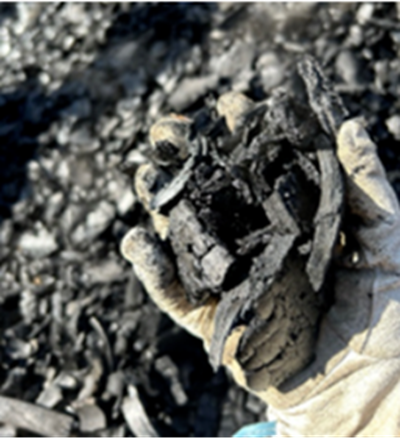
A simple method to estimate pyrolysis temperature and soil carbon sequestration from biochar using the Japanese Industry Standard (JIS) M 8812
The application of biochar to agricultural land contributes to climate change mitigation and soil conservation. In particular, the increase in soil carbon sequestration though biochar has gained attention as a potential basis for carbon dioxide removal credit generation. National Agriculture and Food Research Organization (NARO), in collaboration with Akita Prefectural University, Ritsumeikan University, Wakayama Industrial Technology Center, has developed a method to estimate biochar pyrolysis temperature and associated soil carbon sequestration potential, using analytical values from the Japanese Industrial Standard (JIS M 8812). This approach enables a more practical and cost-effective estimation of carbon sequestration regardless of feedstock type, and is expected to facilitate broader biochar use and improve the efficiency of carbon credit creation.
Read more
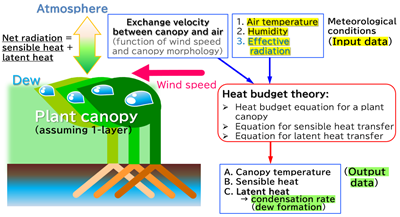
For the first time in the world, the theoretical relationship between dew formation in plant canopies that causes crop diseases and meteorological conditions has been quantified
NARO has quantitatively clarified for the first time in the world the relationship between the tendency of dew formation in plant canopy, which can lead to crop diseases, and meteorological conditions. This advancement enables simple and highly accurate estimation of dew amount and wet duration in plant canopy using weather data. It is expected to contribute to improved prediction of disease outbreaks.
Read more
Treatment with yeast-derived enzyme promotes degradation of biodegradable plastics
The National Agriculture and Food Research Organization (NARO) has demonstrated that an esterase-type enzyme accelerates the degradation of durable polyester biodegradable agricultural mulch films laid in the field. Mulch films are used in vegetable production. A day after the enzyme treatment, the strength of the film decreased, and became fragmented by tillage, with fewer large fragments. This method will make the use of biodegradable plastics easier in a variety of applications and reduce the amount of processed plastic products and their disposal. Read more
Accurate estimation of daily minimum temperature in complex topography
In the case of complicated topography such as hilly mountainous areas and slopes, depending on the location of the farmland, the daily minimum temperature may be nearly 10°C lower than the value of the weather data provided for each 1km mesh. The National Agriculture and Food Research Organization (NARO) has developed a method that can estimate the daily minimum temperature with a 5m mesh, considering the movement of the cold air drainage that occurs with radiative cooling at night. In the future, this result is expected to contribute to the development and provision of accurate weather data for agricultural land located in places where cold air drainage is likely to occur due to complex topography.
Read more
Identification of the amino acid site that regulates the function of the cadmium-manganese transporter protein in rice
Rice plants absorb cadmium and manganese from the roots simultaneously by using OsNRAMP5, a protein localized in the cell membrane. NARO identified the 337th amino acid, which constitutes the OsNRAMP5 protein, as an important site for the regulation of cadmium and manganese transport. Rice plants, in which the amino acid at this site has been changed from glutamine to lysine due to mutation, the uptake of both elements is suppressed, but the amount of manganese necessary for growth can be secured. This result will be useful for the development of rice cultivars with improved safety and productivity.
Read more
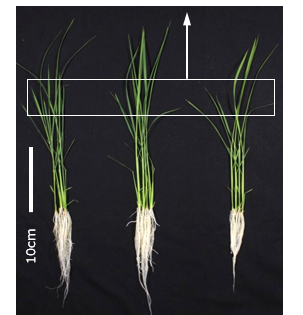
Relative humidity greatly affects the panicle temperature elevation that causes heat-induced sterility of rice
NARO has established an international monitoring network (MINCERnet) of micrometeorology in rice paddy field, which has revealed that heat-induced spikelet sterility (HISS) of rice in paddy fields can be evaluated by using the panicle temperature during the flowering time as an indicator, rather than air temperature under various climates. Under hot and humid climates, the risk of HISS was estimated to be high because the panicle temperature tends to be high due to the low evaporative cooling effect associated with canopy and panicle transpiration. By utilizing this evaluation method, it will be possible to improve the accuracy of predicting HISS worldwide and to take appropriate adaptation measures against HISS under global warming.
Read more
Visualization of the nationwide changes in ecological risks to aquatic organisms due to pesticide usage
NARO has integrated multiple ecological risk assessment techniques that has been developed so far and enabled the visualization of nationwide changes in ecological risks to aquatic organisms due to pesticide usage over time and in regions. As an application example, we assessed the ecological risks, associated with 67 major paddy rice pesticides used in Japan at 350 river sites nationwide and examined the transition over the period from 1990 to 2010. From the result it was revealed that the ecological risk of insecticides was decreased by 92.4% and by 53.1% for herbicides. This study proposes a method to "visualize" the degree of ecological risks rather than the use of pesticides. Hence it can be used to support scientific decision-making by the government, etc.
Read more
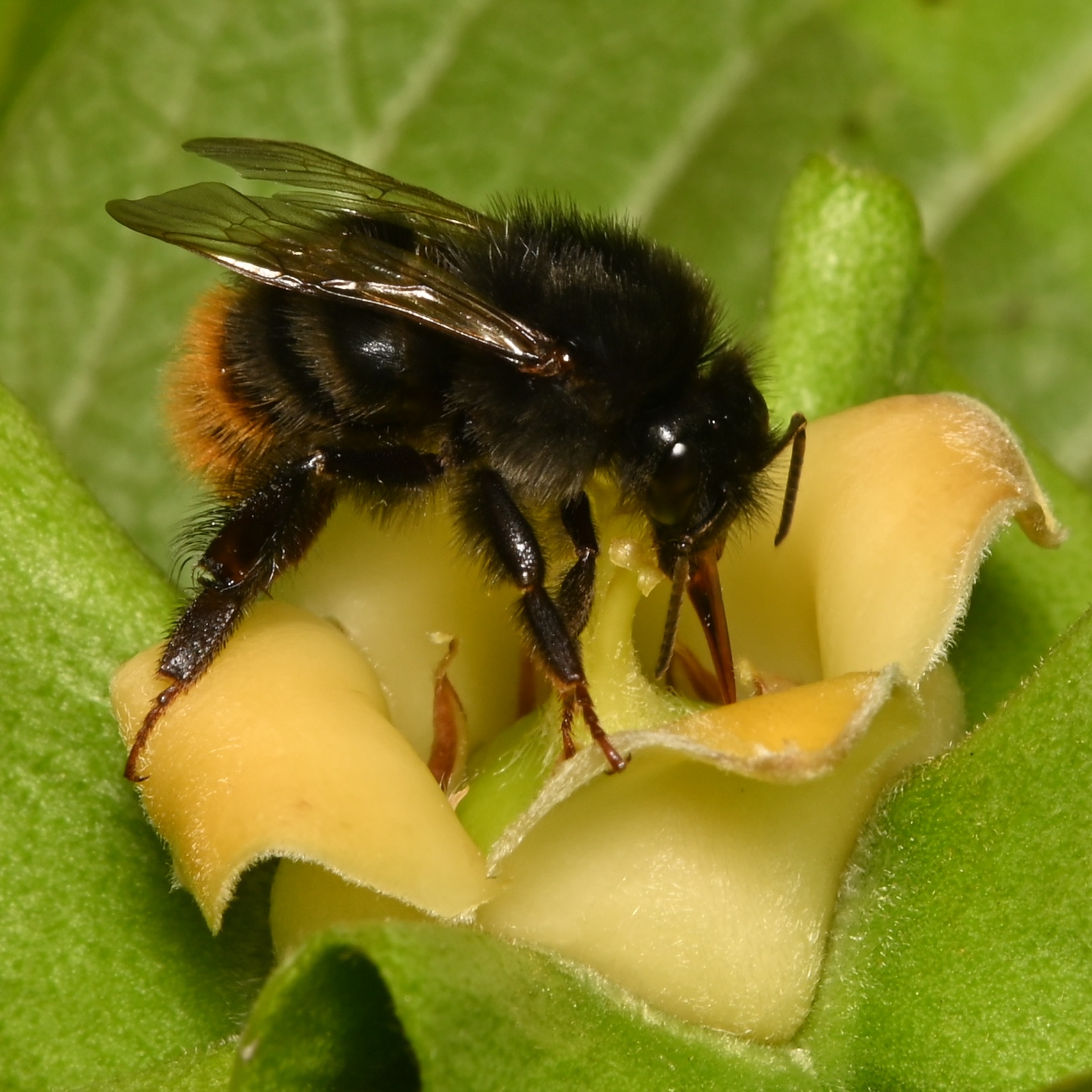
Wild-bee Bombus ardens ardens greatly contributes to persimmon pollination
Wild pollinators are known to be useful in the cultivation of fruit trees and fruit vegetables that require pollination. However, there remained many unsolved points in the actual situation. NARO has developed a survey manual to actively utilize wild pollinating insects and has demonstrated that Bombus ardens ardens, a wild bumblebee species, contributes significantly for pollinating persimmon nationwide. By grasping the contribution of wild pollinating insects in the field, the number of hives of the European honeybee Apis mellifera, which has been introduced as pollinating insects, can be optimized for each region, enabling labor-saving cultivation.
Read more