
The National Agriculture and Food Research Organization (NARO) has demonstrated for the first time that infection of plants by viroids—the smallest known plant pathogens—suppresses the onset of crown gall, a disease that causes severe damage in fruit trees and ornamental crops. With future development of plant vaccines such as attenuated viroids, and as a technology expected to significantly reduce environmental impact through reduced pesticide use, it is expected to be applied to the management of crown gall in fruit trees—as well as in ornamental plants.
Overview
Crown gall disease, which occurs worldwide, is caused by Rhizobium radiobacter and Allorhizobium vitis (hereafter collectively referred to as crown gall pathogens) and leads to the formation of tumor-like swellings called galls (Fig. 1) on plant roots and stems. It primarily affects fruit trees (such as apple, grapevine, and pear), ornamental plants (such as rose and chrysanthemum), and vegetables (such as tomato and potato), leading to poor growth and plant death.
Crown gall pathogens inhabit the soil, and because they can infect newly planted crops even after previously infected plants have died, they cause long-term damage and represent a serious challenge in agricultural production. These bacteria possess genes that induce gall formation in plants, and the proliferation of these galls weakens the plants and ultimately causes them to die. Once symptoms appear, the growth of galls continues even if the bacteria are eliminated, making treatment extremely difficult. Therefore, preventing infection by crown gall pathogens is of great importance.
At NARO, through research on interactions occurring when plants infected with viroids are subsequently invaded by other pathogens, we discovered for the first time that infecting plants with viroids reduces both the incidence of crown gall formation and the diameter of the galls. In promoting integrated pest management, this achievement suggests that viroids could serve as plant vaccines and could open new avenues for research and the development of environmentally friendly agricultural technologies. However, the viroids used in this study possess pathogenicity and cannot be applied directly as plant vaccines. Therefore, future work must focus on identifying and developing attenuated or non-pathogenic viroids suitable for use as plant vaccines.
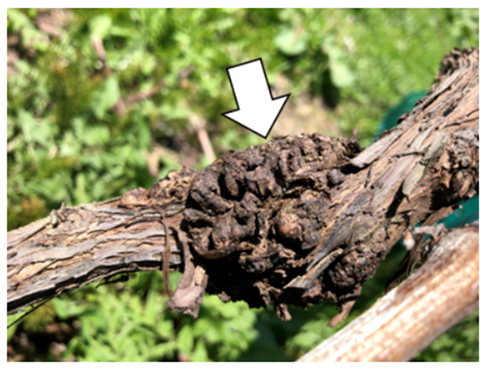
The arrow indicates the gall.
Related Information
Budget: Operating grant