
Because rice stubble is buried in soil and difficult to recover, research on its use as a source of fermentable sugars for ethanol production has been limited compared with rice straw and husks. The National Agriculture and Food Research Organization (NARO) has found that the stubble of the high-biomass rice cultivar "Hokuriku 193" contains sugars equivalent to approximately 60% of those found in the rice straw fraction. In particular, the base of the stem near the ground and the tiller base, which together make up more than 80% of the stubble's weight, were found to yield sugars as efficiently as rice straw when processed through pretreatment and enzymatic saccharification. Going forward, NARO aims to collaborate with companies and other stakeholders to unlock new value in rice stubble as a "hidden carbohydrate resource."
Overview
In rice cultivation, carbon dioxide from the atmosphere is absorbed and converted into organic matter that makes up the crop. Alongside food production, if fermentable sugars can be recovered from non-edible parts of the rice plant such as stems and leaves and converted into ethanol, they may be used for biofuels like SAF (Sustainable Aviation Fuel) and chemical feedstocks, offering the potential for agriculture to contribute to the development of a low-carbon industry. However, Japan faces challenges in biomass utilization compared to countries like the United States, where such practices are more advanced, due to its smaller farmland area per farming entity and the lower proportion of farmland relative to total land area, making it difficult to collect raw materials and therefore essential to maximize the use of non-edible biomass obtained from limited farmland.
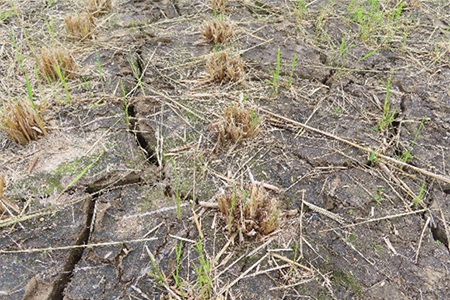
Against this backdrop, NARO is conducting advanced research to further increase the biomass yield of the high-biomass rice cultivar "Hokuriku 193". In this study, we focused on rice stubble, which refers to the basal part of the plant remaining in the field after harvesting (Fig. 1), and investigated its potential usefulness as feedstock for sugar production as it has not previously been utilized for conversion.
As a result, the dry weight of the stubble from "Hokuriku 193" was found to exceed 70% of the rice straw (stem and leaf portion), and the amount of sugar contained was approximately 60% of the sugar content found in the stem and leaf portion. In particular, it was confirmed that the base of the stem near the ground and the tiller base, which together account for more than 80% of the stubble, allowed for efficient sugar recovery comparable to rice straw when subjected to pretreatment using gaseous hydrochloric acid followed by enzymatic saccharification.
Assuming that the amount of rice straw generated domestically is 8.11 million tons and its sugar content is 51.7%, a simple calculation based on the results obtained suggests that more than 2 million tons of sugar may remain in rice stubble across Japan. Recently, technologies for digging up and collecting rice stubble have been under development, and moving forward, NARO plans to collaborate with companies and other stakeholders aiming to utilize regional resources to develop new saccharification processes, with the goal of evaluating the advantages of these methods over current stubble treatment practices.
Related Information
Budget: Operating grants, NARO Innovation Creation Program, NEDO Moonshot R&D Program (JPNP18016)