
The National Agriculture and Food Research Organization (NARO) has developed an AI model that predicts the risks of two soybean physiological disorders: green stem disorder, which makes harvesting difficult, and seed coat cracking, which causes a decline in quality. Using data on soybean cultivars, air temperature, and soil moisture, the model can indicate the risk of occurrence of these disorders and has shown that high temperatures after flowering increase their risk. These research results are expected to contribute to the development of technologies for stable soybean production under climate change.
Overview
In recent years, the effects of climate change—such as high temperatures and drought—have led to a growing number of reports across Japan of physiological disorders in soybeans, including green stem disorder and seed coat cracking, which appear around harvest time. These disorders are thought to arise from the combined effects of multiple factors, including not only climate change but also weather conditions, soil properties, sowing time, and cultivar differences. Green stem disorder reduces harvest efficiency and increases the incidence of stained seeds, while seed coat cracking diminishes product quality, thereby posing a variety of on-farm challenges.
To address these issues, NARO developed an AI model capable of predicting the severity of these disorders based on environmental conditions during growth. The model was trained using approximately 500 soybean cultivation records collected over 16 years at four locations ranging from cool to warm regions, together with air temperature and soil moisture data.
The model revealed that when soybean flowering occurs from summer to early autumn, the risks of green stem disorder and seed coat cracking are strongly influenced by the 10-day average temperatures for days 51-60 and for days 21-30 after flowering, respectively. For both disorders, higher temperatures during the respective post-flowering periods increase the risk.
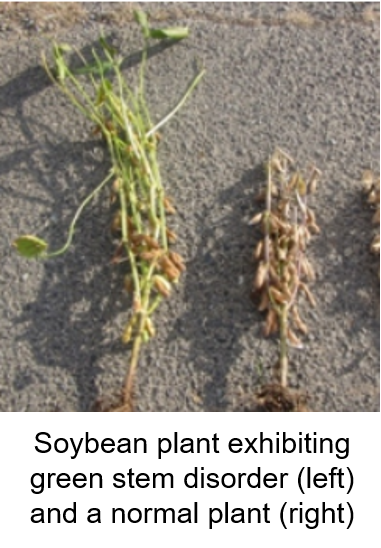
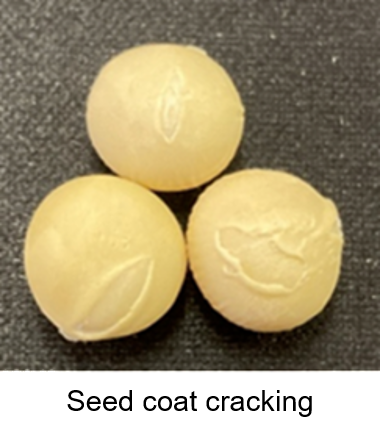
This study is the first to identify the critical periods and environmental conditions associated with increased risks of these soybean disorders—an issue that has been difficult to assess until now. These findings are expected to substantially contribute to the examination of soybean cultivation plans (sowing time, cultivar selection, and management) and to technology development, in preparation for future climate change and environmental variability.
Reference Information
Environment Research and Technology Development Fund "S-18" (JPMEERF20S11806),
Environment Research and Technology Development Fund "S-24" (JPMEERF25S12421)