
A collaborative research team from the National Agriculture and Food Research Organization (NARO), Azabu University, the Hokkaido Research Organization, Meiji University, and the National Federation of Dairy Cooperative Associations conducted a large-scale field study using an independently developed multimodal tail-attached wearable device on approximately 300 calves. Analysis of the collected sensor data showed that diseased calves exhibited a lower activity level, a longer lying (recumbent) time, and a higher surface temperature compared with healthy calves. By comprehensively analyzing these multiple indicators and constructing a disease-detection model using machine learning, the team demonstrated that disease in calves can be detected with reasonable accuracy. These findings are expected to improve labor efficiency and diagnostic accuracy in the field and contribute to the realization of smart livestock systems.
Overview
To achieve labor-saving and highly accurate livestock health management, NARO has led the development of devices designed to be attached to the base of a cow's tail and has developed a multimodal tail-attached wearable device. (See Fig. 1; Reference URL: https://www.maff.go.jp/j/kanbo/smart/forum/R2smaforum/animal/seika71.html)
In this joint study, a collaborative research team from NARO, Azabu University, the Hokkaido Research Organization, Meiji University, and the National Federation of Dairy Cooperative Associations conducted a large-scale field study in which approximately 300 calves were equipped with the multimodal tail-attached device developed by NARO. Analysis of the sensor data revealed that diseased calves tended to show a lower activity level, a longer lying time, and a higher surface temperature than healthy calves. Furthermore, by comprehensively analyzing multiple indicators and applying machine learning techniques, the team developed a disease detection model that could distinguish diseased calves from healthy ones with reasonable accuracy. These findings contribute to the realization of labor-saving and highly accurate health management for calves. In the future, further improvements to this technology, together with integration of the findings obtained in this study with non-wearable sensing systems such as automatic milk feeders and camera-based image analysis, are expected to enhance identification of disease types and improve detection accuracy.
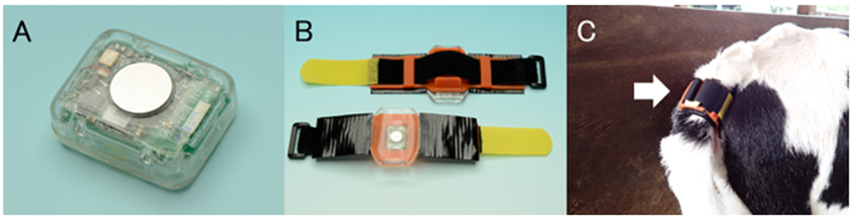
A: Multimodal tail-attached sensor
B: Sensor mounting device
C: Example of the device attached to a calf
Related Information
Funding: Japan Racing Association (JRA), Special Promotion Grant Program
"Development of Smart Health Management Technology for Dairy Calves (2022-2024)"
Patents:
Patent No. 7643679: Livestock health management system, wearable device for livestock, method and program for livestock health monitoring
Patent No. 7291944: Wearable device for livestock, sensor mounting tool, and mounting method