The National Agriculture and Food Research Organization (NARO) has developed a new type of functional silk that enables enzymes to be immobilized (fixed in place) at desired positions on natural silk fibers derived from silkworm cocoons.
Enzymes accelerate reactions that produce target compounds and are widely used in environmentally friendly production processes. However, enzymes are difficult to recover after reactions and therefore difficult to reuse, which has been a major challenge for their practical application.
The newly developed functional silk enables desired enzymes to be immobilized at predetermined positions on silk fibers. This technology allows enzymes to function stably on silk and facilitates their reuse. In the future, the ordered arrangement of multiple enzymes could enable sequential enzymatic reactions, which is expected to contribute to more efficient and environmentally friendly production of pharmaceuticals, food ingredients, biomaterials, and related products.
Overview
In modern biotechnology industries, immobilized enzyme technologies are already widely utilized for the production of pharmaceuticals, foods, and biofuels, forming a foundation for large-scale production. However, conventional immobilization methods generally attach enzymes to the surfaces of carriers such as beads, making it difficult to precisely control the spatial arrangement and sequence of enzymes at the nanometer scale. As a result, there have been structural limitations in designing sophisticated multienzyme reaction systems that require efficient cooperation among multiple enzymes.
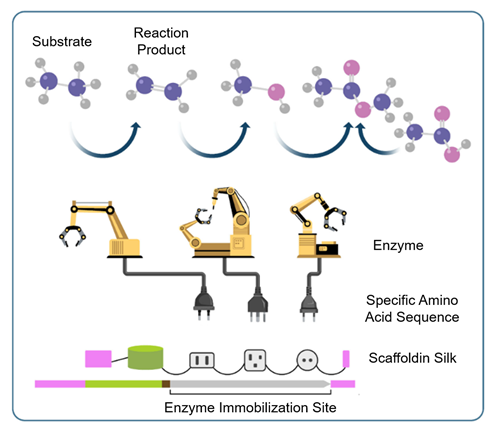
To overcome this challenge, NARO developed functional silk (scaffoldin silk), a new technology that enables not only enzyme immobilization but also the selective placement of enzymes at designated locations on silk fibers (Fig. 1).
This technology was inspired by the scaffold structures used by bacteria during cellulose degradation. NARO reconstructed on silk a system that allows multiple enzymes to function in an organized manner. In this study, genes encoding several bacterial scaffold structures were introduced into silkworms to produce recombinant silk containing binding sites capable of selectively immobilizing three different enzymes (Fig. 2). The research team attached a cellulose-degrading enzyme (cellulase) to one of these binding sites and confirmed that the reaction proceeded successfully on the silk.
The scaffold structure remains functional and stable at temperatures up to approximately 60°C. Therefore, below this temperature, the silk can be processed into fibers or molded materials while maintaining its functionality. Furthermore, because silk is a naturally derived and biodegradable material, it is expected to provide a new sustainable alternative to conventional petroleum-based materials.
Moving forward, NARO will explore applications of this technology through collaborations with researchers and companies interested in constructing continuous reaction systems for the production of a wide range of high-value products.

Fig. 1. Diverse industrial applications supported by enzymes
Enzymes are utilized in a wide range of industrial sectors, including food production, pharmaceuticals, chemicals, bioenergy, environmental technologies, textiles and paper manufacturing, and cosmetics, because of their high specificity and efficiency. To create a new silk-based material applicable to these diverse fields, NARO has developed functional silk that enables enzyme immobilization and utilization.