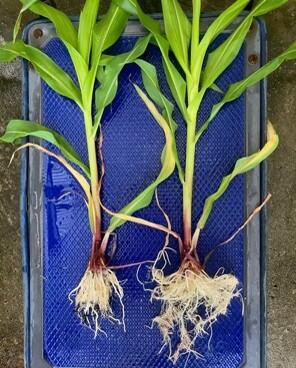
To improve feed self-sufficiency in Japan, we promote the development and dissemination of leading forage crop cultivars that are adaptable to climate change, including global warming. For maize, we utilize its wild relative, teosinte, which has high tolerance to waterlogging, to develop high grain-yielding, waterlogging-tolerant cultivars that can be cultivated even in converted paddy fields with poor drainage. For forage grasses, we promote the adoption of a new festulolium cultivar, "Natsuhikari," which combines high summer survival with excellent early growth comparable to that of Italian ryegrass. In addition, we aim to elucidate the occurrence and ecological characteristics of plant diseases, the risks of which are increasing under global warming, and to develop disease-resistant varieties. Furthermore, we conduct foundational research to apply advanced breeding technologies, such as genomic prediction and genome editing, to forage crop breeding. Through these efforts, we will develop leading forage crop cultivars using advanced breeding technologies and contribute to the stable supply of high-quality domestic feed.