
A research team from the National Agriculture and Food Research Organization (NARO), Nippon Soda Co., Ltd., and Hokkaido University has newly discovered hatching stimulants for Globodera pallida—one of the most destructive pests affecting potatoes globally—with simple chemical structures that are suitable for large-scale synthesis. In field trials, treatments with these compounds achieved a substantial reduction in population density of G. pallida in the soil. This achievement represents a step toward realizing a completely new mode-of-action control strategy and is expected to make a significant contribution to sustainable potato production.
Overview
One of the world's most destructive potato pests, the pale potato cyst nematode, G. pallida, was first detected in Japan in 2015, prompting an urgent need to establish control measures. In response, control techniques using trap crops have been developed and implemented. However, because pests such as G. pallida are difficult to control, an integrated pest management approach combining multiple control methods is required, and thus further development of control technologies remains essential.
G. pallida eggs hatch in response to specific "hatching stimulants" secreted from host plant roots. However, if the hatched juveniles cannot parasitize a host, they lose infectivity within a few weeks and eventually die (starvation). By utilizing this characteristic, it is possible to actively reduce G. pallida populations by inducing hatching in the absence of host plants (Fig.1). This phenomenon is referred to as "suicide hatching."
Although the development of control methods utilizing this characteristic has been attempted in the past, the hatching stimulants identified from host plants have extremely complex chemical structures, making synthesis difficult and preventing practical application.
Therefore, we conducted a large-scale screening using compound libraries and other resources, with the objective of identifying hatching stimulants for pest-control applications that are not limited to plant-derived substances, have simple chemical structures, and are suitable for large-scale synthesis. As a result, we discovered a group of compounds with simple chemical structures that exhibit strong hatching stimulation activity against G. pallida. After synthesizing one of the promising candidates and applying it in G. pallida-infested fields, we successfully achieved a substantial reduction in G. pallida population density in the soil.
These results represent a step toward realizing a completely new mode-of-action control strategy—"tricking G. pallida into hatching and leading them to starvation"—and are expected to contribute to sustainable potato production through the realization of efficient and reliable G. pallida control.
These research findings have been published in the international journal Plant Disease.
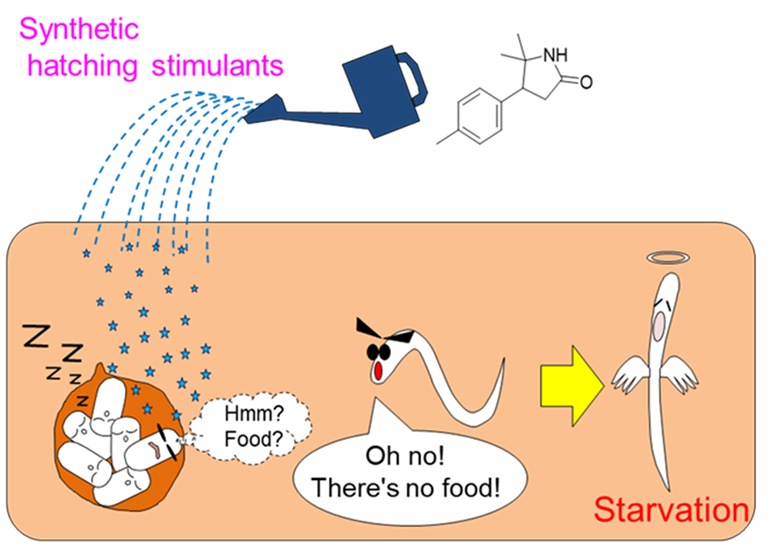
Hatching stimulants are recognized by the nematodes as cues indicating the presence of host plants. By using synthetic hatching stimulants, this cue is taken advantage of to "trick" the nematodes into hatching in the absence of host plants, ultimately leading them to starvation.
Publication
Kushida A, Kanazawa J, Sakata I, Ikeda Y, Kitayama T, Kato K, Itabashi T, Sugimoto Y, Koizumi S, Osawa Y, Inoue T and Tanino K (2025) Discovery of hatching stimulants for Globodera pallida with simple chemical structures and their application for nematode density reduction in soil. Plant Disease. https://doi.org/10.1094/PDIS-03-25-0667-RE
Related Information
This work was supported by grants from the Project of the Bio-oriented Technology Research Advancement Institution, NARO (the special scheme project on advanced research and development for next-generation technology).
Patent: JP7628231B2 "Globodera pallida control agent"