
The National Agriculture and Food Research Organization (NARO) has developed a robot that automatically performs lower-leaf removal in tomato plants. Lower-leaf removal is one of the most labor-intensive tasks in high-wire cultivation, and is the second most critical operation after harvesting. Consequently, it is the most prioritized task for automation. The developed robot uses a specialized end-effector mounted on a robotic arm to automatically prune unnecessary leaves. This system is expected to reduce labor requirements—such as personnel costs and working hours—which currently account for around 30% of total production costs.
Overview
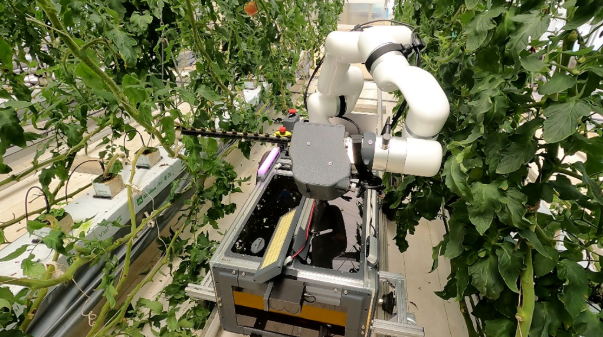
Tomato de-leafing is a process of pruning unnecessary leaves from the lower part of the main stem in high-wire cultivation, a method used for long-term tomato production (Fig. 1). Until now, this task has traditionally been performed manually, but automation using the newly developed robot (Fig. 2) enables significant labor-savings in cultivation management.
In developing this robot, NARO has introduced several new technologies, including an AI-based image analysis method to recognize the parts and shapes of tomato plants, a newly designed end-effector based on a hedge trimmer that enables efficient lower-leaf removal, and a control method that guides the end-effector precisely along the main stem. These advancements allow the end-effector to move along the stem and continuously remove lower leaves, while force control system—using reaction forces applied to the end effector—enables it to smoothly follow the natural curvature of the main stem. Unlike previous devices generally focused on detecting and cutting individual leaves one by one and therefore faced challenges in accuracy, operational speed, and applicable conditions, this new technology does not require precise leaf position detection and can remove multiple leaves at once, improving work efficiency.
Building on this technology, NARO aims to develop a multi-use robot capable of performing various tasks—such as harvesting and pesticide spraying—simply by replacing the end-effectors. If a single robot can handle both lower-leaf removal and harvesting, total labor time in tomato production is expected to be reduced by 40%, contributing to improved efficiency and productivity in agricultural settings where labor shortages are becoming increasingly severe.
A video demonstrating the robot's lower-leaf removal operation is available at the link below:
Video Link: https://youtu.be/varnociD_mc
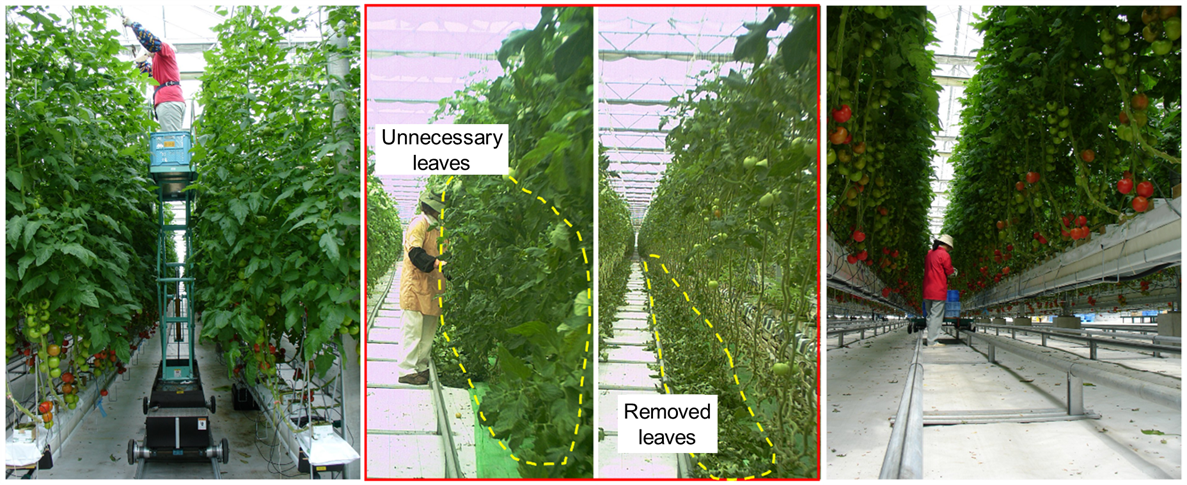
Left: Lateral shoot removal, training, and lowering
Center: Lower-leaf removal (before and after)
Right: Harvesting
Related Information
Budget: grants from the NARO, the JSPS KAKENHI Grant-in-Aid for Scientific Research (B) (Grant No. 25K02135), and donations (Tokai Pickles Co., Ltd.)
Patents: JP 2024-078291 A, JP 2024-081238 A, JP 2024-081954 A