
Rice straw, a key domestic resource for producing bioethanol, is difficult to use efficiently because of its bulkiness, making its transport and storage challenging. To address this issue, the National Agriculture and Food Research Organization (NARO) and Ashidachi Lime Co., Ltd. have developed "the CaPPA Process," a method that compresses rice straw after lime pretreatment to reduce its volume. The resulting high-density material not only improves transportability and storability, but also shows better sugar-release performance, making it easier to supply, store, and utilize as a regional bioethanol feedstock. Going forward, collaboration with lime manufacturers and bio-based companies as potential feedstock processing hubs will accelerate the industrial application of this process.
Overview
Rice straw contains fermentable sugars that can be extracted and converted into ethanol, allowing it to be used as an environmentally friendly biofuel or as a raw material for chemical products. However, because rice straw is very porous and bulky, even when baled, it is inefficient to transport and store, resulting in a limited stable supply to the users and leaving large amounts unused in fields. To solve this issue, it is necessary to establish a system in which baled rice straw is transported over short distances to nearby feedstock processing hubs, where it undergoes primary processing and densification.
NARO and Ashidachi Lime Co., Ltd. discovered that chopped rice straw becomes much easier to compress after lime pretreatment at room temperature, and named this method "the CaPPA Process" (Calcium hydroxide Pretreatment for Pressing Agricultural by-products). When rice straw treated with lime is pressed under heat, its bulk density increases compared to untreated straw (from 0.10 g/cm3 to 0.23 g/cm3) (Fig. 1).
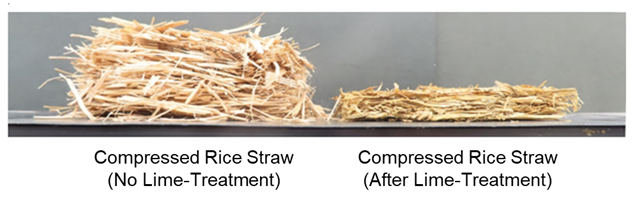
The CaPPA Process not only makes rice straw denser but also greatly improves its usability. First, lime pretreatment makes rice straw much easier to break down into sugars. By pressing it into stable, high-density pellets, the material becomes a feedstock that is easy to store and measure (i.e., ease of accurately measuring a feedstock with consistent quality), allowing it to be supplied not only to large bioethanol plants but also to municipal facilities and small- to medium-sized businesses. Furthermore, by stockpiling highly storable pellets over long periods, it is expected that agricultural biomass can offer new decarbonization benefits, similar to harvested wood products currently counted as part of the "carbon pool."
Going forward, NARO will continue working with lime manufacturers and other potential processing hubs to advance and verify the CaPPA technology. Furthermore, sugar-conversion and fermentation technologies—along with compact equipment suitable for smaller-scale use—will be developed in collaboration with bio-based companies. These efforts aim to support regional low-carbon development and contribute to the creation of a Japan-style bioeconomy.
Related Information
Budget:
- NARO: Operating grant and joint research budget
- Ashidachi Lime Co., Ltd.: Joint research budget
Patent: Application filed