
The National Agriculture and Food Research Organization (NARO) and Nanao Kogyo Co., Ltd. have developed a new technology to restore the performance of aged asphalt using C-AG, a novel material synthesized from renewable resource-derived saccharides and fatty acids. Unlike conventional rejuvenation methods that rely on petroleum-derived oils to replenish asphalt components, this technology restores flexibility by modifying the internal microstructure of asphalt. By integrating biotechnology and materials chemistry, this innovation is expected to reduce environmental impacts, promote resource circularity, and contribute to sustainable infrastructure renewal in the GX (Green Transformation) era.
Overview
Asphalt is an important infrastructure material widely used for applications such as road pavement and building waterproofing. In Japan, more than 99% of used asphalt is recycled. However, asphalt that has been used and recycled repeatedly over long periods gradually deteriorates due to exposure to heat and ultraviolet radiation, becoming hard and brittle. As a result, conventional rejuvenation technologies face limitations in restoring asphalt quality.
C-AG is a novel material synthesized from saccharides, such as starch, and fatty acids through the integration of biotechnology and materials chemistry. NARO has previously demonstrated that C-AG can function as an asphalt modifier capable of controlling properties such as flowability and durability. (NARO press release, 2022: https://www.naro.go.jp/publicity_report/press/laboratory/nfri/153477.html)
In this study, we found that the addition of C-AG to aged asphalt provides a rejuvenation effect that differs from the conventional approach of replenishing asphalt components with petroleum-derived oils. C-AG forms fibrous structures within the asphalt and restores flexibility by altering its microstructure. As a result, we demonstrated that aged asphalt can be rejuvenated to properties close to those of undeteriorated asphalt.
These findings were published online on February 20, 2026, in ACS Sustainable Resource Management, a journal of the American Chemical Society. Further research will be conducted toward the practical implementation of this technology.
Video
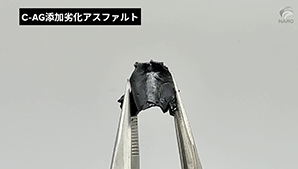
Comparison of the flexibility of undeteriorated asphalt, aged asphalt, and aged asphalt containing C-AG, demonstrated by bending the specimens with tweezers.
Note: The aged asphalt specimens were prepared by heating asphalt at 80°C for 60-180 days.
Related Information
Funding: Operating grants and funded collaborative research
Patent: Japanese Patent No. 7701057