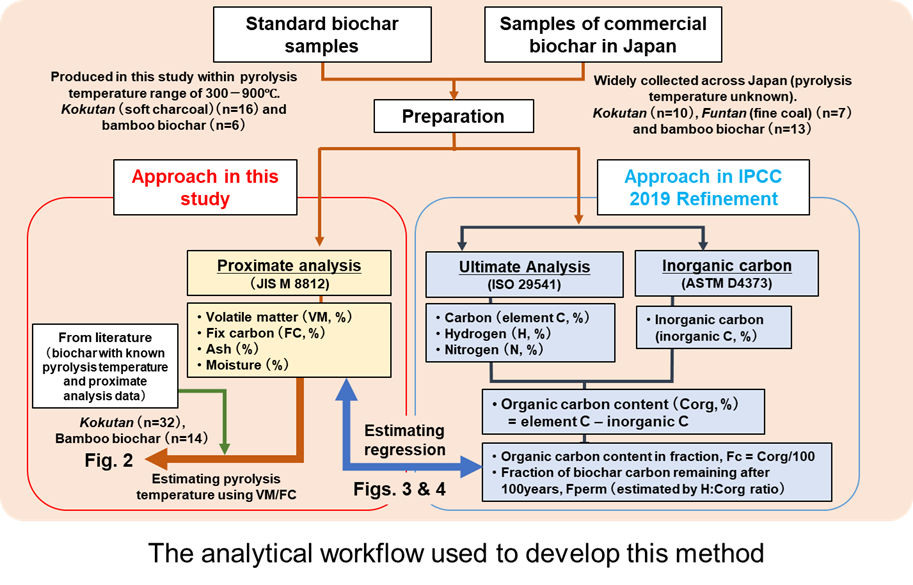
The application of biochar to agricultural land contributes to climate change mitigation and soil conservation. In particular, the increase in soil carbon sequestration though biochar has gained attention as a potential basis for carbon dioxide removal credit generation. National Agriculture and Food Research Organization (NARO), in collaboration with Akita Prefectural University, Ritsumeikan University, Wakayama Industrial Technology Center, has developed a method to estimate biochar pyrolysis temperature and associated soil carbon sequestration potential, using analytical values from the Japanese Industrial Standard (JIS M 8812). This approach enables a more practical and cost-effective estimation of carbon sequestration regardless of feedstock type, and is expected to facilitate broader biochar use and improve the efficiency of carbon credit creation.
Overview
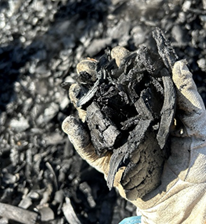
Biochar derived from bamboo
Biochar is a solid material generated by heating biomass (organic matter derived from biological sources) to a temperature exceeding 350°C undercontrolled oxidant conditions to prevent combustion. The carbon content of biochar depends on the pyrolysis temperature and feedstock types. The carbon in biochar is highly resistant to decomposition and is internationally recognized as an effective method for long-term carbon sequestration in soils.
To generate carbon credits through biochar application, it is necessary to quantify both the amount of carbon applied and its long-term stability. According to the 2019 Refinement to the IPCC Guidelines for National Greenhouse Gas Inventories, the carbon sequestration potential is calculated using the mass of biochar applied, the fraction of biochar organic carbon content (Fc), and the fraction of biochar carbon that remains after 100 years factor (Fperm). The estimation equation is as follows:
Carbon Sequestration (t CO2) = Biochar Mass (t, dry weight) × Fc × Fperm × 44/12
Although the 2019 Refinement provides default values for Fc and Fperm, these values vary depending on feedstock types and pyrolysis temperatures. In particular, when the pyrolysis temperature is unknown, or when using feedstocks not specified in the 2019 Refinement, it is necessary to obtain these data through measurements such as elemental analysis, which requires significant time and cost. This has become a burden for businesses seeking to create carbon credits using biochar.
In the newly developed method, instead of conducting elemental analysis, the proximate analysis based on JIS M 8812, originally used for coal quality evaluation, is applied. Using proximate analysis values of biochar, such as volatile matter (VM) and fixed carbon (FC), this method estimates the pyrolysis temperature and the carbon sequestration potential of biochar applied to agricultural land. Proximate analysis based on JIS can be conducted by authorized institutions in Japan with assured measurement accuracy. Additionally, by developing and sharing feedstock-specific conversion formulas among research institutions, the efficiency of biochar quality assessment can be improved, ultimately streamlining the careation of carbon credits through biochar.
Publication
Kurimoto Y, Kishimoto-Mo A. W, Kajimoto T, Ozawa F and Shibata A (2024) Estimating soil carbon sequestration with woody and bamboo biochar using the Japanese Industrial Standard (JIS) M 8812. Carbon Management, 15(1). https://doi.org/10.1080/17583004.2024.2438228
Related Information
Budget: This study was supported by the Ministry of Agriculture, Forestry and Fisheries of Japan (MAFF) through the Commissioned Project "Enhancing Carbon Sequestration Capacity in Agricultural Soils through Biochar Development" (Grant Number JP J008722).
For Inquiries
Contact: https://www.naro.go.jp/english/inquiry/index.html