
National Agriculture and Food Research Organization (NARO) is developing a genome editing method that employs virus-based vectors capable of systemic delivery into plants, enabling the generation of genome-edited plants without the integration of foreign DNA. A research team from NARO, the University of Tokyo, and Ryukoku University successfully established an approach that combines a modified version of AsCas12f—a compact and highly efficient genome editing enzyme—with a Potato Virus X (PVX) derived vector. This method achieved more than a 30-fold increase in the efficiency of generating genome-edited plants compared to using SpCas9 as the major genome editing enzyme. This significant advancement is expected to enable the application of efficient and simple genome editing technologies, free from foreign DNA, to a broader range of plant species.
Overview
Genome editing is a technology that enables targeted modification of specific genes and is expected to serve as an advanced crop breeding technique for rapidly developing crops that meet societal needs.
To generate genome-edited plants, the common approach is to insert the gene that encodes a genome-editing enzyme into the plant genome to induce genome editing. Because crops that contain this genome-editing enzyme gene, which is foreign DNA, are classified as transgenic plants, seeds are collected from genome-edited plants, and null-segregant progenies lacking the genome-editing enzyme gene are selected. However, this method is unsuitable for plants that reproduce vegetatively, such as tuber crops and fruit trees, or for species that take a long time to produce seeds.
In contrast, the virus vector method using RNA virus-derived vectors (hereafter virus vectors) carrying the genome-editing enzyme gene does not require integration of foreign DNA into the plant genome. Instead, the genome-editing enzyme gene replicates as part of the viral genome within plant cells and moves cell-to-cell, thereby inducing genome editing. Consequently, regenerating plants from leaves inoculated with the virus vector enables the production of genome-edited plants free from foreign DNA.
NARO has previously succeeded in generating genome-edited plants free from foreign DNA by using a virus vector based on potato virus X (PVX), which mainly infects Solanaceae plants, carrying the gene encoding SpCas9, a major genome editing enzyme(https://doi.org/10.1093/pcp/pcaa123).
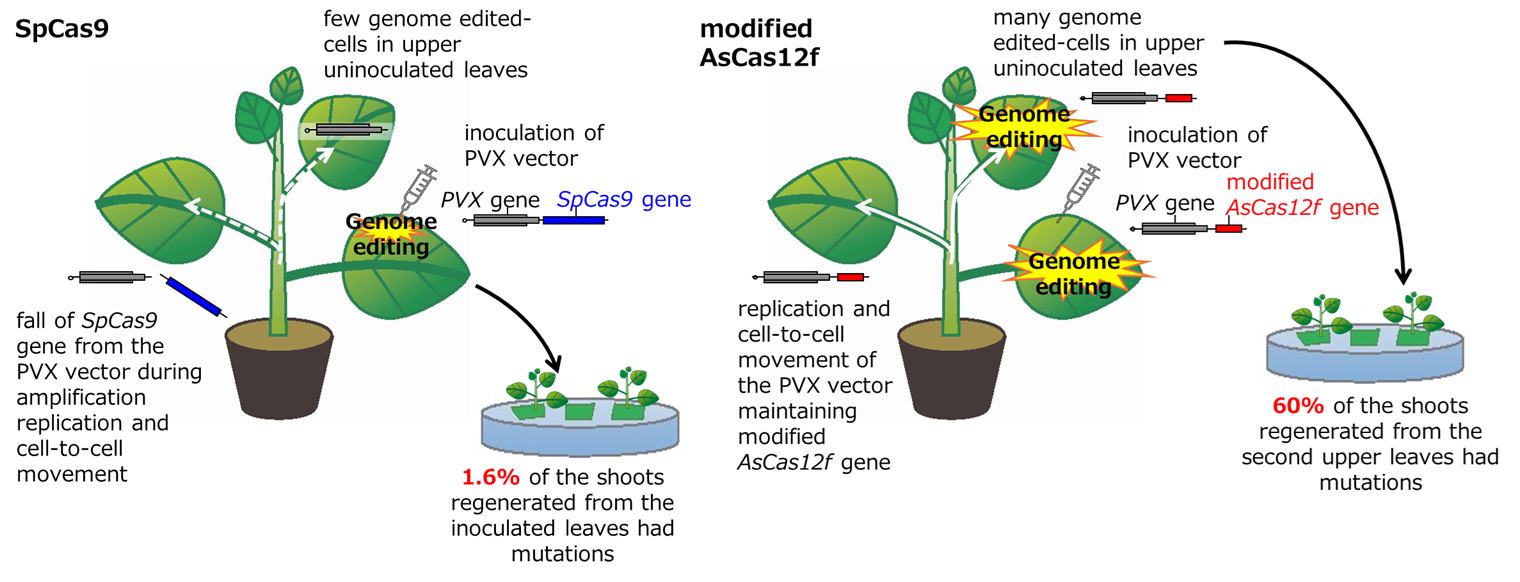
However, the efficiency of obtaining genome-edited plants using this method was only 1.6%, posing a significant challenge (Fig. 1, left). This low efficiency was attributed to the large size of the SpCas9 gene, which often fell out from the PVX vector during replication and cell-to-cell movement, resulting in genome editing occurring in only a small fraction of cells.
To address this issue, the present study employed a modified version of AsCas12f—a compact genome editing enzyme with high editing activity—developed by a research team led by the University of Tokyo. When the PVX vector carrying the modified AsCas12f gene was introduced into the leaves of Nicotiana benthamiana, a model plant of the Solanaceae family, genome-edited plants were obtained with a high efficiency of 60% (Fig. 1, right).
Furthermore, NARO has developed a method for eliminating viral vectors from plant cells during the regeneration process of plants from edited leaves. Moving forward, we aim to establish a simple and efficient method for producing plants free from both virus vectors and foreign DNA by combining genome editing using virus vectors carrying modified AsCas12f with the virus elimination technique, thereby enabling application to a wider range of plant species.
This research has been published in the international journal Frontiers in Plant Science.
Publication
Ishibashi K, Sukegawa S, Endo M, Hara N, Nureki O, Saika H and Toki S (2024) Systemic delivery of engineered compact AsCas12f by a positive-strand RNA virus vector enables highly efficient targeted mutagenesis in plants. Frontiers in Plant Science, 15:1454554.
https://doi.org/10.3389/fpls.2024.1454554
Related Information
Budget:
・Commissioned project by the Japan's Ministry of Agriculture, Forestry and Fisheries (MAFF): "Development of crop varieties and breeding materials utilizing genome editing technology" (JPJ008000)
・Public/Private R&D Investment Strategic Expansion PrograM (PRISM): "Establishment of a functional module data platform for genome editing enzymes"
・Cross-ministerial Strategic Innovation Promotion Program (SIP): "Building a sustainable food chain that provides abundant food" (Research implementing agency: Bio-oriented Technology Research Advancement Institution) (JPJ012287)
Patent:
Engineered protein (Japanese patent application No. 2025-032046)