
Nitrous oxide (N2O), a potent greenhouse gas contributing to global warming, is emitted from farmland, and methods to suppress its release are being explored worldwide. A joint research group from National Agriculture and Food Research Organization (NARO), Tohoku University, Obihiro University of Agriculture and Veterinary Medicine, and RIKEN has developed a technology that enables soybean plants to preferentially establish symbiosis with rhizobia exhibiting high N2O-reducing capacity. This technology was shown to reduce the amount of N2O released during the decomposition of soybean root nodules in the soil. By suppressing N2O emissions from soybean fields, this innovation is expected to contribute to mitigating the progression of global warming.
Overview
N2O is one of the major greenhouse gases, with a global warming potential 265 times greater than that of carbon dioxide. Agricultural activities that sustain human food supply account for approximately 60% of anthropogenic N2O emissions (IPCC Fifth Assessment Report, 2013), with emissions from farmland representing a significant proportion. Nitrogen is an essential nutrient for plant growth; however, large quantities of nitrogen fertilizers applied to farmland, as well as unharvested crop residues, are known sources of N2O emissions. Consequently, the development of technologies to reduce N2O emissions from farmland has become a globally important challenge.
Rhizobia are soil microorganisms that establish symbiosis inside root nodules of leguminous plants such as soybean, supplying atmospheric nitrogen as a nutrient to the host plant. Furthermore, some rhizobia possess the ability to reduce N2O to dinitrogen, a major component of the atmosphere that does not directly contribute to the greenhouse effect.
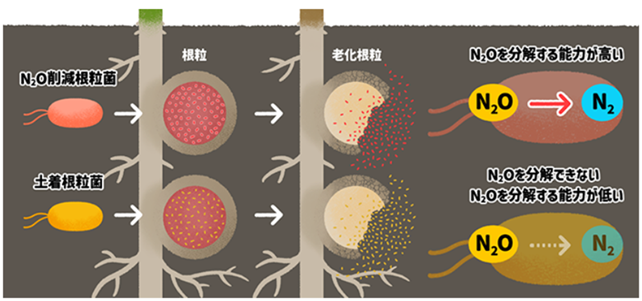
To this end, trials have been conducted to inoculate soybeans with N2O-reducing rhizobia that possess high N2O-reducing rhizobia and promote their symbiosis, thereby reducing the N2O released during the decomposition of root nodules after harvest (Fig. 1). However, soils in farmland harbor diverse indigenous rhizobia, many of which either lack N2O-reducing capacity or possess only weak capacity (Fig. 1). When soybeans are planted and inoculated with N2O-reducing rhizobia, infection competition with indigenous rhizobia occurs, and the majority of nodules end up being colonized by the indigenous strains. Consequently, the proportion of nodules hosting N2O-reducing rhizobia remains low, and the overall N2O-reduction potential cannot be fully achieved (Fig. 2, left).
To overcome this limitation, the joint research group established a soybean-rhizobium symbiotic system that increases the proportion of nodules colonized by N2O-reducing rhizobia by leveraging a phenomenon known as symbiotic incompatibility. This phenomenon occurs when soybeans carrying specific incompatibility genes recognize effector proteins secreted by certain rhizobia and block their infection. The research group developed soybean lines harboring two incompatibility genes and selected N2O-reducing rhizobia that had naturally lost the ability to produce the effectors. Combining these enabled N2O-reducing rhizobia to preferentially infect and form nodules with soybeans carrying incompatibility genes (Fig. 2, right).
Laboratory experiments showed that, in soybeans with incompatibility genes, more than 90% of nodules were colonized by N2O-reducing rhizobia, and N2O emissions from soil were reduced to 15% of that in soybeans lacking incompatibility genes. Furthermore, field trials demonstrated that nodule occupancy by N2O-reducing rhizobia reached 64%, and N2O emissions were reduced to 26% compared to uninoculated plots.
Soybean is cultivated worldwide as a source of food, feed, and oil. Soybean cultivation is inherently a low-emission food production system; however, the technology developed in this study enables a substantial reduction in N2O emissions from soybean fields, facilitating more environmentally sustainable soybean production and contributing to global warming mitigation.
This study was published in the scientific journal Nature Communications on September 4, 2025.
Publication
Nishida H, Itakura M, Win KT, Feng L, Kakizaki K, Suzuki A, Ohkubo S, Duc LV, Sugawara M, Takahashi K, Shenton M, Masuda S, Shibata A, Shirasu K, Fujisawa Y, Tsubokura M, Akiyama H, Shimoda Y, Minamisawa K, Imaizumi-Anraku H (2025) Genetic design of soybean hosts and bradyrhizobial endosymbionts reduces N2O emissions from soybean rhizosphere. Nature Communications, 16:8023.
https://doi.org/10.1038/s41467-025-63223-6
Related Information
Budget: Moonshot R&D Program by NEDO: "Reduction of Greenhouse Gas Emissions from Farmland through Optimization of Resource Circulation" (Project ID: JPNP18016)
Patent: "Rhizobium and Method for Inoculating Leguminous Plants with Rhizobium"
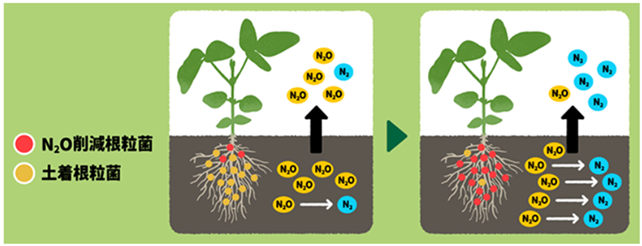
(Right)By blocking infection by indigenous rhizobia and increasing the proportion of nodules occupied by N2O-reducing rhizobia (drawn with red circles on the roots), we developed a soybean-rhizobium symbiotic system that maximizes the N2O-reduction effect.