
Melons ripen rapidly after harvest, resulting in a short shelf life that contributes to food waste and limits their suitability for long-distance transport and overseas exports. In collaboration with the University of Tsukuba and Sanatech Life Science Co., Ltd., NARO has applied a proprietary genome-editing technology co-developed by NARO and its external partner, the in planta Particle Bombardment (iPB) method, to melons. By inactivating a gene involved in fruit ripening, the team has developed a muskmelon with improved shelf life and adjustable ripening. This achievement is expected to enable distribution to distant regions within Japan and low-cost sea-freight exports, thereby boosting domestic consumption and expanding global market opportunities for melons.
Overview
In recent years, melon production in Japan has been declining. This trend is driven by a shortage of growers and labor, as well as the challenges of cultivation and fluctuations in market prices, leading to reductions in both cultivated area and shipment volume. Under these circumstances, the sustainable development of the melon industry requires technological innovations that enhance labor efficiency and production stability, and the development of new varieties that deliver value to producers, distributors, and consumers. In particular, "long shelf life" is one of the key breeding goals, as it directly contributes to reducing the risk of food waste, lowering distribution costs, and stabilizing prices.
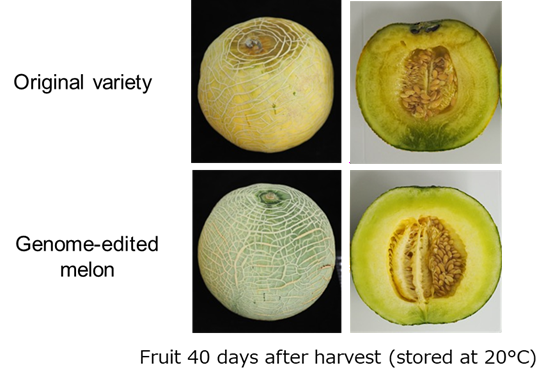
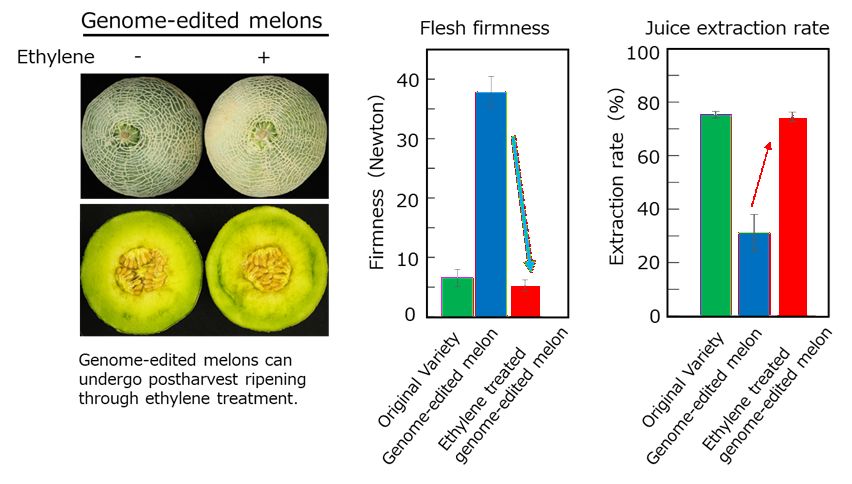
To improve the shelf life of melons, the research team consisting of NARO, the University of Tsukuba, and Sanatech Life Science Co., Ltd. focused on a gene called CmACO1, which is involved in melon fruit ripening. CmACO1 is a gene for an enzyme that synthesizes ethylene, a plant hormone. After harvest, melons release ethylene, which causes the fruit to soften and become sweeter; however, once the optimal ripening period has passed, deterioration progresses. The team hypothesized that inactivating the CmACO1 gene through genome editing would prevent ethylene production and result in a melon that ripens more slowly and has a longer shelf life. By applying the proprietary genome-editing technology, the in planta Particle Bombardment (iPB) method—co-developed by NARO and Kaneka Corporation—to melon, plants with an inactivated CmACO1 gene had already been obtained, and it had been confirmed that these plants released almost no ethylene, as previously reported (2023 Research Activity Report: https://www.naro.go.jp/project/research_activities/laboratory/nias/158244.html). In this study, genome-edited melons produced using the iPB method were evaluated for shelf life, and even more than one month after harvest, the rind remained green and the flesh remained firm (Fig. 1). Furthermore, it was confirmed that exposing these genome-edited melons to ethylene enabled them to ripen normally and reach peak eating quality. When the fruit was treated with a high concentration of ethylene for 24 hours on the seventh day after harvest, the flesh softened within three days after treatment, and its juiciness increased, reaching a condition almost equivalent to that of a normally fully ripened melon (Fig. 2). These findings indicate that "on-demand" ripening after harvest is possible, offering significant advantages such as reduced risk of food waste and opportunities for expanding overseas exports. It is worth noting that ethylene-based ripening is already a common practice for imported bananas.
This achievement offers several advantages: producers can decide the timing of harvest more flexibly; distributors can reduce costs related to maintaining freshness and transportation after harvest; and consumers can enjoy fruit that was previously available only during a limited season for a longer period. These benefits represent a significant step toward expanding domestic demand for melons and promoting overseas exports. Going forward, notifications to the relevant ministries and variety registration will be carried out, with the aim of introducing the product to the market in about three years.
Related Information
Patents;
"Plant Genome Editing Method," Japanese Patent No. 7236121, Patent No. 7321477
"Genome Editing Method," Japanese Patent No. 7416383, Patent No. 7416384
"Method for Producing Transformed Plants," Japanese Patent No. 6967217
Budget;
Cross-ministerial Strategic Innovation Promotion Program (SIP2):
"Smart Bio-industry and Agricultural Infrastructure Technology"
"Development of Precision Genome Editing Platform Technologies Contributing to Bio-industry and Agriculture"