In Japan, the standard language based on the Tokyo dialect is effectively used as the official language, but there are various local dialects in Japanese. The Japanese dialects vary greatly in all aspects among the regions, including vocabulary, grammar, phonology and accent. Even Japanese people often experience difficulties when they move or travel to a different region.
For example, the standard term "Arigato (Thanks)" is "Taihen" in Fukushima, "Ohkini" in Kyoto, "Dandanna" in Kumamoto, and "Nihe-de-biru" in Okinawa. Such locally unique terms are still used.
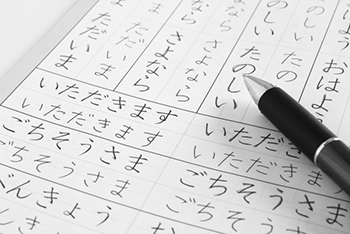
General Japanese sentences are written in a mixture of Kanji and Hiragana. Foreign words are expressed in Katakana, but some are written in Kanji. Hiragana/Katakana has a single pronunciation per character, but Kanji characters have several different pronunciations, and many Kanji characters have the same pronunciation.
Literature differs in terms of written language (writing-style) and spoken language (speaking-style). In particular, there is a significant difference at the end of sentences. In addition to differences between these two styles, there are different forms and conversation styles according to social position/status, such as gender, age, and occupation of the speakers. Especially, terms that show respect for others are unique, and Japanese people use expressions and phrases while constantly changing from one style to another.
Currently, the number of people using Japanese language is approximately 130 million. This number is considered to be within the top 10 in terms of the number of native speakers worldwide.