Rental housing in Japan usually requires a guarantor, in addition to paying fees such as key money, a security deposit, and other deposits to the owner at the time of the contract. Contracts with owners are generally concluded between a lessee and a landlord through a real estate company. Rent varies depending on the area and location, the age of the building, and the floor plan. For example, the rental rate of a 1 LDK (1 bedroom plus dining kitchen) apartment ranges from ¥60,000 to ¥70,000 in Tsukuba City and from ¥50,000 to ¥60,000 in Fukushima City, Fukuyama City, and Kurume City.
Due to the high population density, a typical house in Japan is small in size, and apartments are also "narrow". This gives the impression that kitchen, bath toilet, and living room are neatly arranged within a compact floor space.
In Japan, which is very humid in June and July, there are many wooden rental housing units. Because these apartments prioritize ventilation, they tend to hot in summer and cold in winter. Additionally, due to thin walls, residents can occasionally hear the voices of their neighbors.
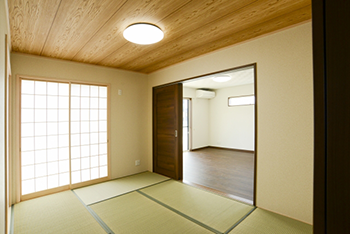
In addition to western-style rooms, Japanese houses also have Japanese-style rooms (washitsu) that are unique to traditional Japanese houses. A washitsu room efficiently utilizes limited space because it is finished with flooring material, called tatami. On the other hand, since tatami is a mat made from igusa, a type of soft rush, it can develop mold and mites to occur due to moisture, especially during the rainy season, in June and July. On sunny days, it is necessary to open windows, ventilate the room and use a vacuum cleaner to prevent mold and mites.
Finally, many rental houses are not equipped with furniture or home appliances. There are some apartments equipped with furniture and home appliances for a limited period of time called "Monthly Mansion" or "Weekly Mansion." However, the rental fee of such rental houses are relatively high and other miscellaneous expenses may be necessary.