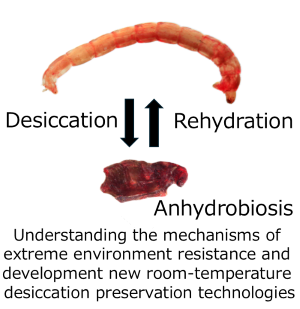
We investigate how organisms survive extreme conditions such as desiccation, freezing, and highly acidic environments, and apply those insights to next-generation biotechnologies. Our main research models are the sleeping chironomid Polypedilum vanderplanki, which survives severe desiccation through a reversible ametabolic dormant state known as anhydrobiosis, and Pv11, a cultured cell line derived from this insect that retains remarkable desiccation tolerance. By uncovering the molecular basis of anhydrobiosis, we aim to develop technologies that allow cells and biomaterials to be stored, transported, and used at ambient temperature without refrigeration. Our long-term vision is to reduce dependence on the cold chain and enable more sustainable and accessible applications in medicine, drug discovery, environmental sensing, and biomanufacturing.